
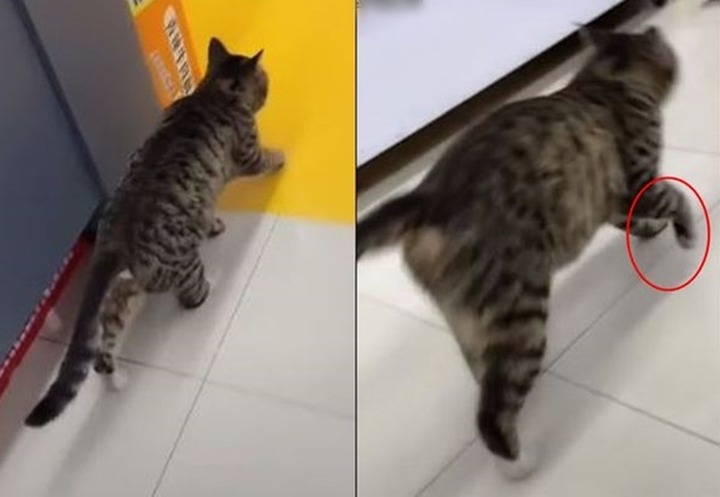
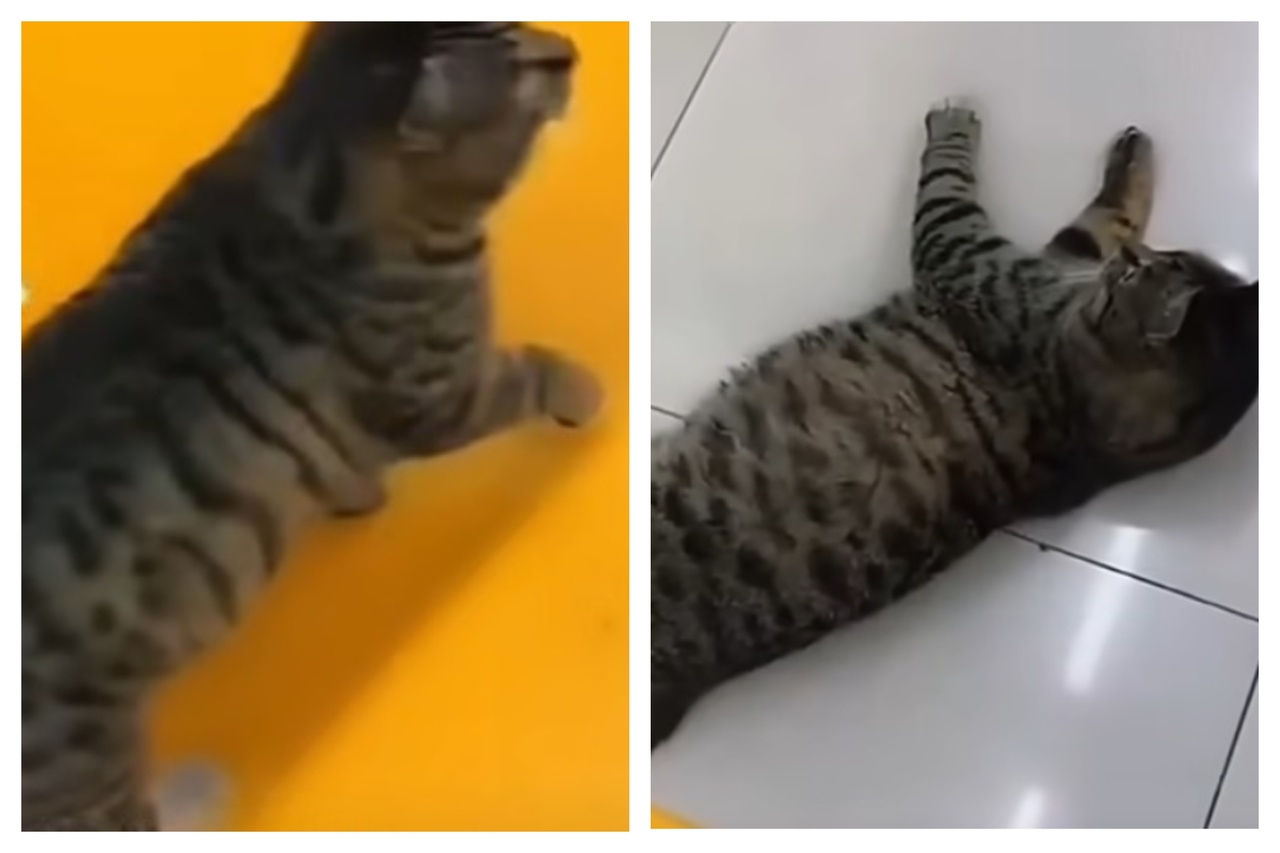
One ordinary afternoon in a supermarket in Yichun, a quiet city in Heilongjiang Province, shoppers paused their routines for an unexpected reason. Near the yellow line at the entrance, a small cat stood still, glancing around as if checking its audience. Moments later, it lifted one paw and began walking slowly on three legs, wearing what many described as an expression of gentle distress.
Customers gathered. Some crouched down to pet the cat. Others offered food. A few reached for their phones.
Yet what made the scene truly fascinating was this detail: outside the supermarket, the same cat reportedly walked normally on all four legs, agile and energetic. According to a report by VTC News, supermarket staff in Yichun observed that the cat appeared healthy. However, once inside, it would consistently “pretend” to limp, seemingly to attract sympathy.
The video quickly spread online. Social media users affectionately dubbed the feline an “award-winning actor.” But beyond the humor and viral charm, the story raises intriguing questions about animal intelligence, cultural symbolism, and human interpretation.
A Viral Sensation: What Happened in Yichun?
According to local reports, the cat had no visible physical issues. Before entering the store, it moved with full mobility. But as soon as it crossed the threshold, it changed its gait. It would pause, survey its surroundings, then lift its right paw and begin walking with a noticeable limp.
Supermarket employees captured the behavior on video and shared it online. Viewers were captivated. Many praised the cat’s “acting skills,” joking that it deserved admission to a prestigious drama academy. Others commented that even animals must “work hard” for food.
Whether intentional or instinctive, the cat’s behavior resonated with millions because it felt surprisingly relatable. The idea of adapting one’s behavior to circumstances is deeply human, yet here it appeared in a small animal navigating a busy public space.
Are Cats Capable of Strategic Behavior?
To understand this phenomenon, we turn to science.
Research in animal cognition suggests that domestic cats are more perceptive than they are often given credit for. Studies from institutions such as Kyoto University have shown that cats can recognize their names and distinguish familiar human voices from strangers. Behavioral researchers have also documented that cats adjust their vocalizations and gestures depending on their environment and the responses they receive.
Could the Yichun supermarket cat have learned that limping results in increased attention and food? It is possible.
Animals, including cats, learn through associative conditioning. If a specific action consistently leads to a positive outcome such as petting or feeding, that behavior may be reinforced over time. From a scientific standpoint, the cat’s limp could be an adaptive strategy shaped by repeated experience.
However, it is important to frame this carefully. There is no verified evidence proving deliberate deception. What appears to humans as “acting” may simply be a learned behavioral pattern. Interpretation often depends more on human imagination than on confirmed animal intent.

The Cultural Meaning of Cats in China
Beyond science, the story carries cultural weight.
In Chinese folklore, cats have long held symbolic roles. In some regions, they are seen as guardians of homes and granaries, protecting food supplies from rodents. In other traditions, cats are associated with mystery and independence. Their calm observation and sudden shifts in behavior often inspire storytelling.
While the Yichun cat is not part of a mythological tale, the public reaction reflects a broader cultural tendency to anthropomorphize animals. When viewers describe the cat as an “actor,” they are projecting human characteristics onto it. This storytelling impulse is universal.
In Chinese internet culture especially, animals that display unusual or clever behavior often become lighthearted icons. They are celebrated not only for what they do but for what people imagine they represent: wit, resilience, or humor in everyday life.
Anthropomorphism: Why We See Ourselves in Animals
Anthropomorphism is the human tendency to attribute thoughts, emotions, and intentions to non-human beings. Psychologists suggest that this instinct helps people connect emotionally with animals.
In the case of the supermarket cat, viewers interpret its limp as intentional performance. The narrative becomes entertaining because it mirrors human behavior. We recognize strategy, adaptation, and even theatrical flair.
Yet scientific caution reminds us to separate observation from assumption. The cat may not understand sympathy in the way humans do. Instead, it may simply respond to patterns. If lifting a paw increases interaction, the behavior is likely to continue.
The line between storytelling and science is delicate. Both perspectives enrich our understanding, but they operate differently.
Animal Intelligence and Urban Survival
Urban environments present unique challenges for stray or semi-domesticated animals. Food sources are unpredictable. Human interaction varies. Animals that adapt effectively are more likely to thrive.
Research in urban ecology shows that animals often modify their behavior to coexist with humans. Raccoons open containers. Pigeons navigate train stations. Dogs learn traffic patterns.
Cats, known for their observational skills, are particularly adept at reading human cues. They can distinguish between welcoming and hostile body language. Over time, subtle changes in posture or movement may develop as part of survival strategies.
In this context, the supermarket cat’s behavior could be interpreted as adaptive intelligence rather than theatrical performance.
Social Media and the Rise of Animal Celebrities
The Yichun cat’s popularity also reflects the power of digital storytelling. In the era of short-form video platforms, animals with distinctive behaviors quickly capture global attention.
From “talking” huskies to dancing parrots, viral animal content taps into universal emotions. Viewers seek comfort, humor, and connection. The supermarket cat fits this pattern perfectly. Its behavior is simple, repeatable, and visually compelling.
Yet viral fame also amplifies interpretation. Online audiences often embellish narratives. A cat lifting a paw becomes a “master actor.” A routine habit becomes a dramatic performance.
This is not necessarily misleading, but it demonstrates how storytelling shapes perception.
Ethical Considerations: Caring for Stray Animals
While the story is amusing, it also highlights a broader issue: the welfare of stray animals.
If the cat regularly visits the supermarket seeking food, it suggests reliance on human generosity. Urban communities around the world face similar questions about how to responsibly support stray animals.
Experts recommend structured feeding programs, veterinary checkups, and cooperation with local animal welfare organizations. Compassion is important, but long-term well-being requires consistent care.
In this case, the cat’s popularity could potentially draw positive attention to responsible animal support initiatives in the region.
Myth, Humor, and Modern Curiosity
Across cultures, animals that behave unexpectedly often enter folklore. Stories of clever foxes, loyal dogs, and mysterious cats appear in countless traditions. These tales blur the line between reality and imagination.
The supermarket cat belongs to this modern folklore category. Though grounded in a real event, its meaning evolves through retelling. Each viewer adds interpretation. Some see intelligence. Others see coincidence. Many simply see charm.
The balance between myth and science is not a conflict but a dialogue. Science seeks explanation. Myth seeks meaning. Both respond to the same source: human curiosity.
What Can We Truly Conclude?
Based on available reports, there is no confirmed medical issue affecting the cat. Observers note that it walks normally outside the store. Inside, it lifts one paw and moves more slowly.
Scientifically, this could represent learned behavior reinforced by positive outcomes. Culturally, it becomes a playful symbol of adaptability. Digitally, it becomes a viral story.
The truth likely lies somewhere between instinct and interpretation. Animals are capable of complex learning, but humans are equally capable of imaginative storytelling.
A Reflection on Why Stories Like This Matter
In a world filled with serious headlines, a simple story about a cat in a supermarket offers relief. It reminds us that curiosity extends beyond science labs and academic journals. It lives in everyday moments.
Why did the cat change its gait? Was it strategy, coincidence, or something in between? The precise answer may remain uncertain. Yet the question itself sparks conversation about intelligence, empathy, and how humans relate to the natural world.
Perhaps that is the deeper significance of the “supermarket actor cat.” Not whether it truly performed, but how quickly people connected with it. We are drawn to stories that reflect our own behaviors back at us, even in unexpected forms.
In watching a cat pause at a yellow line, glance at its audience, and lift a paw, we see more than an animal. We see adaptation. We see imagination. We see ourselves wondering.
And in that wondering, human curiosity continues its quiet performance.
Sources
VTC News. Report on the supermarket cat in Yichun, Heilongjiang Province.
Bradshaw, John. Cat Sense: How the New Feline Science Can Make You a Better Friend to Your Pet. Basic Books.
Kyoto University studies on feline name recognition and social cognition.
American Veterinary Medical Association resources on feline behavior and learning.
National Geographic articles on animal intelligence and urban wildlife adaptation.



Leave a Reply