
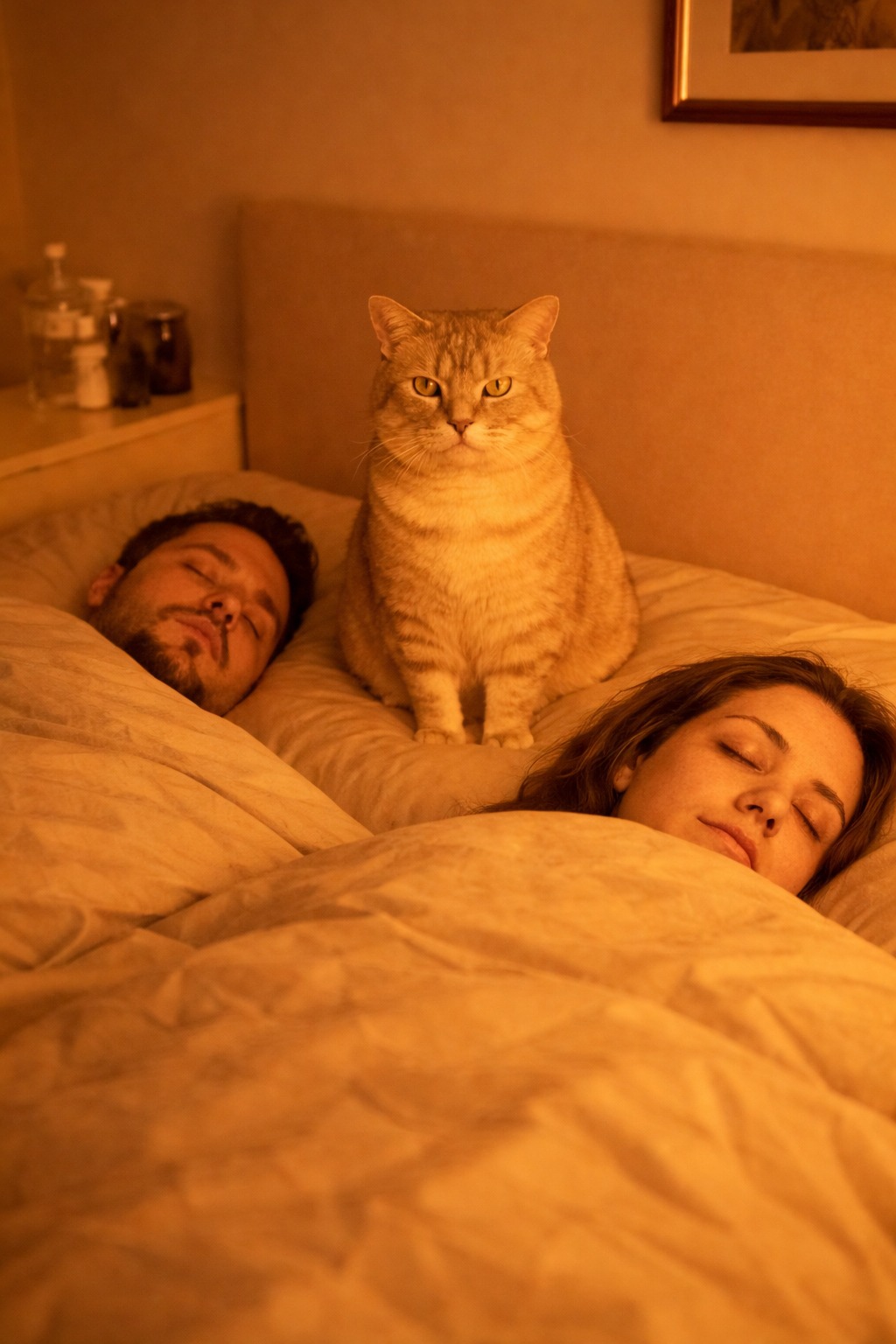
It began with a feeling.
Not a loud crash. Not a sudden movement. Just that strange awareness that makes your eyes open in the middle of the night for no clear reason. A subtle shift in the air. A quiet sense that something isn’t quite right.
For one couple, that feeling led to an unexpected discovery — not about something supernatural, but about something deeply biological. What first seemed unsettling turned out to be a remarkable example of how closely pets observe the humans they love.
This story opens the door to a bigger question: Can cats detect health changes in their owners? And if so, how?
When a Pet’s Behavior Suddenly Changes
Changes in a pet’s nighttime routine can feel alarming. Cats are creatures of habit. When they suddenly stop sleeping in their usual spot or begin acting unusually alert at night, it’s natural to wonder why.
In this case, the family cat began sitting beside the bed, staring intently — not in an aggressive way, but in a focused, watchful manner. During the day, she was completely normal. Eating. Napping. Purring. But at night, she appeared to be on duty.
At first, it felt eerie.
Later, it felt extraordinary.
The Science Behind Feline Awareness
Cats possess heightened senses that far surpass human capabilities.
Their hearing can detect subtle frequency changes.
Their sense of smell is significantly more sensitive than ours.
Their ability to notice small movements is highly refined.
Because of these traits, cats often respond to environmental or physiological shifts long before humans recognize them.
Research in animal behavior suggests that pets may detect:
Changes in breathing rhythm
Subtle scent variations linked to hormone levels
Alterations in heart rate
Muscle tension or movement irregularities
While scientists continue studying these abilities, many documented cases show pets responding to medical events such as seizures, blood sugar fluctuations, or breathing disruptions.
Importantly, these reactions are not mystical. They are rooted in biology.
Sleep Apnea and Breathing Irregularities
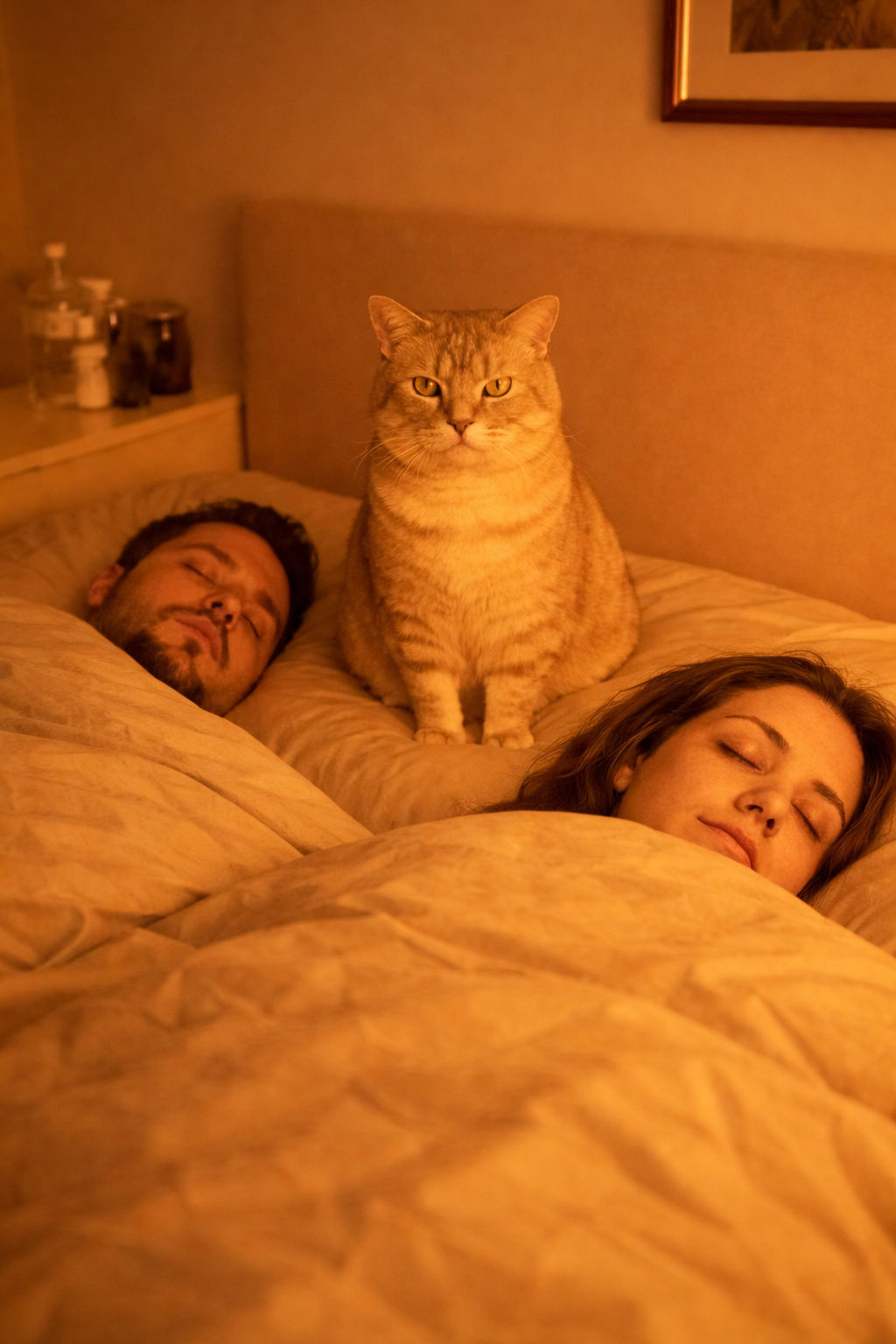
In the case described above, the husband was later diagnosed with sleep apnea — a condition in which breathing repeatedly pauses during sleep.
According to medical organizations such as the American Academy of Sleep Medicine, sleep apnea can go undiagnosed for years. Many people are unaware their breathing stops briefly during the night.
When breathing pauses, oxygen levels shift slightly. The body responds. Subtle changes occur in scent, movement, and airflow.
To a human partner, these pauses may blend into normal nighttime sounds.
To a cat with highly tuned senses, they may stand out immediately.
How Animals Detect Breathing Changes
Cats rely heavily on pattern recognition. Once they learn the rhythm of household activity — footsteps, voices, sleep sounds — deviations become noticeable.
When breathing slows or pauses, several detectable cues may occur:
Reduced chest movement
A change in airflow sound
Altered body scent due to oxygen shifts
Micro-movements signaling stress in the body
A cat observing from close range may respond instinctively to these irregularities.
In some cases, pets nudge, paw, or vocalize when they detect something unusual. This behavior is often interpreted as random nighttime restlessness — until patterns emerge.
Medical Alert Animals vs. Natural Instinct
There is an important distinction between trained medical alert animals and untrained pets who react naturally.
Service dogs can be professionally trained to recognize seizures, diabetic blood sugar changes, and other conditions. Their responses are shaped through reinforcement and conditioning.
Cats, however, are rarely formally trained for medical alert roles. When they react to health changes, it is generally instinctive rather than taught.
That instinct likely stems from:
Close physical proximity
Routine exposure to normal breathing patterns
Heightened sensory perception
Strong social bonding
When an irregular pattern appears, their curiosity and alertness are triggered.
Why Cats May Seem “Creepy” at Night
Cats are naturally more active during twilight and nighttime hours. Their vision is adapted for low light, and their internal clocks differ slightly from human sleep cycles.
When a cat sits silently in the dark, watching, it can feel unsettling — especially when half awake. Their large pupils, still posture, and quiet presence can amplify that sensation.
But from a biological perspective, the behavior is often neutral:
They may be observing movement.
They may be responding to sound.
They may be monitoring a change.
The human mind fills in the mystery.
The Emotional Layer: Interpreting Animal Behavior
When we experience unexplained pet behavior, our imagination often jumps ahead of evidence.
Fear can distort perception.
In the story above, what first felt like being watched by something eerie turned out to be careful observation rooted in concern — not fear, not threat, just attention.
Animals do not conceptualize protection in the dramatic ways humans do. However, they do form strong social bonds. Studies on human–animal attachment show that pets often synchronize their behavior with their owners, mirroring emotional states and responding to distress signals.
Over time, familiarity becomes awareness.
Awareness becomes response.
After Diagnosis: Behavior Returns to Normal
Once treatment for sleep apnea began — typically involving a CPAP machine that stabilizes breathing — the cat’s nighttime monitoring stopped.
This shift supports the idea that her behavior was tied to irregular breathing patterns rather than random activity.
When the rhythm normalized, her watchfulness was no longer needed.
She returned to her regular sleeping spot.
Routine restored. Balance regained.
Can All Cats Detect Health Changes?
Not every cat will respond this way. Individual temperament varies widely.
Some cats are highly observant and socially engaged. Others are more independent and less attentive to human physical patterns.
Factors that may influence responsiveness include:
Level of attachment to the owner
Sleeping proximity
Sensitivity to sound and scent
Past reinforcement (intentional or unintentional)
It’s important not to assume that a lack of reaction means a lack of bond. Each animal expresses connection differently.
When to Take Behavioral Changes Seriously
If a pet suddenly becomes unusually focused on a specific family member — particularly during sleep — it may be worth observing patterns.
While pets are not diagnostic tools, unusual behavioral shifts can sometimes prompt useful medical evaluation.
Warning signs that justify medical consultation include:
Frequent breathing pauses
Loud snoring with gasping
Chronic daytime fatigue
Morning headaches
Sleep apnea is common and treatable, and early detection improves long-term health outcomes.
Pets may not replace medical devices, but they sometimes act as unexpected observers.
The Broader Fascination With Animal Intuition
Stories of animals sensing medical events captivate us because they blur the line between instinct and intuition.
Humans are deeply curious about what animals perceive beyond our awareness.
Do they sense things we miss?
Do they understand our vulnerability?
Do they act with intention?
Science explains much of this through sensory capability and pattern recognition. Yet emotionally, it feels more profound.
When a pet responds to subtle physical changes, it reminds us how deeply intertwined our lives are with the animals who share our homes.
The Quiet Vigil of Companionship
In many households, pets witness the most unguarded parts of our lives — the late nights, the restless sleep, the quiet breaths in darkness.
They learn our rhythms.
They memorize our patterns.
And sometimes, when something shifts, they react.
Not dramatically.
Not heroically.
Just attentively.
That attentiveness can look eerie in the dark. But more often than not, it reflects something simple: connection.
Final Reflection: Curiosity in the Quiet Hours
Human curiosity thrives in moments of uncertainty. When something unexplained happens at 3:17 a.m., imagination fills the silence quickly.
Yet often, the answer is not supernatural or mysterious.
It is biological.
It is sensory.
It is relational.
The night that once felt unsettling became a reminder of how closely we are observed by the animals who live beside us. Not in judgment. Not in surveillance.
In awareness.
Perhaps what moves us most is not that a cat noticed a breathing pause. It is that she responded — quietly, consistently, without needing recognition.
In the stillness of night, long before machines hummed and diagnoses were confirmed, there was simply a small creature sitting beside a pillow, refusing to blink.
And sometimes, that is enough to make us look at our pets — and our own vulnerability — with renewed appreciation.






Leave a Reply