
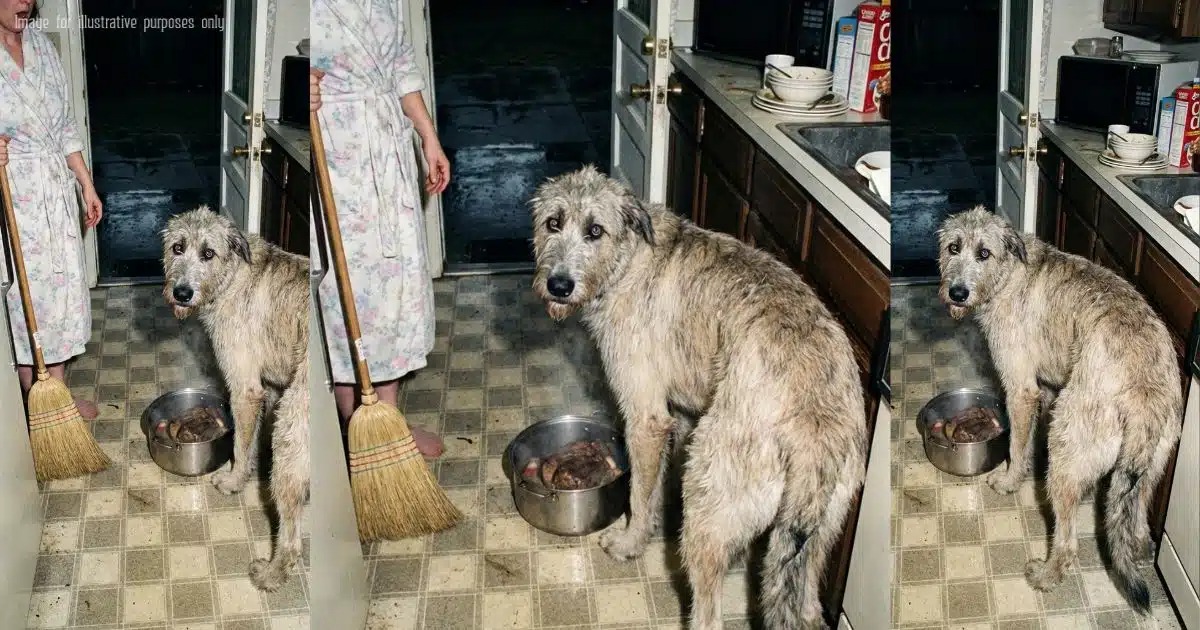
“I caught my 120-pound dog dragging a fully cooked pot roast out the back door. I grabbed a broom to stop him, not realizing he was about to teach me the most painful lesson of my life.”
Barnaby was a mistake. At least, that’s what my husband, Dave, always said. He was supposed to be a menacing guard dog, a mix of Wolfhound and something that looked like a bear. Instead, he was a rug. A giant, shedding, slobbering rug who was afraid of thunder and let the mailman pet his belly.
It was 1998. The economy in our town was drying up like the lawns in August. Dave’s hours at the plant had been cut, and I was stretching every dollar until it screamed.
Meat wasn’t just food; it was currency.
So, when the leftovers started disappearing, I was furious.
First, it was a foil-wrapped turkey sandwich. Then, a bag of apples. Then, the incident that broke me: an entire Sunday meatloaf.
I knew it was Barnaby. He had been acting strange all week—pacing by the back screen door, whining low in his throat, refusing to eat his kibble. I figured he was just being a glutton, saving room for the human food he planned to steal.
“That dog has to go outside tonight,” Dave said, looking at the empty platter where our dinner used to be. “We can’t afford to feed a thief.”
I was so angry I could have cried. I threw Barnaby out into the backyard. It was raining, a cold, miserable drizzle. He didn’t scratch at the door to come back in. He just grabbed the meatloaf—which he’d hidden behind the sofa—and bolted into the dark.
“Oh no, you don’t,” I muttered. I grabbed my raincoat and a flashlight. I was going to catch him in the act and rub his nose in it.
I followed his muddy paw prints through the wet grass. He didn’t stop at his doghouse. He went straight to the back of the property, where our fence met the old wooded lot behind the subdivision. There was a gap in the wood there, hidden by overgrown blackberry bushes.
Barnaby squeezed through. I climbed on a stump to look over the fence.
What I saw made the flashlight shake in my hand.

Barnaby wasn’t eating.
He was sitting in the mud, wagging his tail so hard his whole body shook. In front of him, sitting on a overturned bucket under the shelter of an old oak tree, was a boy.
It was Leo.
I knew Leo. He was the quiet kid from three streets over. The one who wore long sleeves in the summer. The one whose dad had “gone to California to look for work” two years ago and never came back. The neighborhood gossip was that his mom was working three jobs, but nobody ever really saw her.
Leo looked like a skeleton in a soaking wet windbreaker.
Barnaby nudged the meatloaf toward him with his nose.
Leo didn’t grab it. He broke off a piece, ate it quickly, and then broke off another piece.
“Here, Barnaby,” the boy whispered. His voice was raspy. “You take half. You’re hungry too.”
My giant, gluttonous dog, who would normally inhale a steak in two seconds, gently took the small piece from the boy’s hand. He ate it slowly, just to be polite. Then he nudged the rest back to the boy.
Barnaby wasn’t stealing food because he was greedy. He was stealing it because he knew his friend was starving.
I turned off the flashlight. I didn’t want to blind them. I didn’t want to shame them.
I walked back to the house, sat on the kitchen floor, and cried.
I thought about the “Budget” I stressed over. I thought about how I yelled at Barnaby for “wasting” food. Meanwhile, my dog—an animal with no concept of money or economy—had more humanity in his paw than I had in my whole body.
He saw what we refused to see. We saw a quiet kid. Barnaby saw a hungry pack member.
When Barnaby finally scratched at the door an hour later, I didn’t scold him. I dried him off with the good towels.
“You’re a good boy,” I whispered into his damp fur. “You’re the best boy.”
The next day, the conspiracy began.
I didn’t call Child Protective Services. In our neighborhood, you knew that making “The Call” meant the kid went into the system, and the system was a monster that chewed families up. Leo didn’t need a caseworker; he needed dinner.
I started cooking “badly.”
“Oh, for heaven’s sake,” I said loudly, opening the back door. “I burned the edges of these pork chops. Dave won’t eat them. Barnaby, get this garbage out of here.”
I wrapped three chops in foil—warm, not burned at all—and handed them to the dog.
Barnaby looked at me. Original work by Pawprints of My Heart. He knew. His tail gave a single, solid thump against the doorframe. He took the package and trotted toward the fence.
We did this for six months. Extra sandwiches in the lunchbox. “Accidental” spills of bags of bagels. Barnaby became the courier. He never ate the delivery. Not once.
Eventually, Leo’s mom got a better job at the hospital. The lights in their house stayed on. Leo started gaining weight. The meetings at the fence stopped, but Barnaby still sat by the back door every evening, just checking.
Years went by. Barnaby got old. His hips gave out, and his muzzle turned gray.
When we finally had to put him down, it was the hardest day of my life. We buried him in the backyard, right near the gap in the fence.
I was standing over the fresh dirt, holding his collar, when a truck pulled up.
A young man stepped out. He was tall, broad-shouldered, wearing a mechanic’s uniform. It took me a moment to recognize the eyes.
It was Leo.
He didn’t say a word. He walked past me, knelt by the grave, and placed something on the dirt.
It was a foil-wrapped package. Inside was a prime rib bone, the expensive kind, with plenty of meat left on it.
He stood up, wiped his eyes with grease-stained knuckles, and looked at me.
“He kept me alive, ma’am,” Leo said, his voice thick. “I was invisible to everyone else. But he saw me.”
“I know,” I said.
“He was a good dog.”
“No,” I corrected him. “He was the best of us.”
We live in a world that loves to complicate charity. We set up forms, qualifications, and judgments. We ask why someone is poor before we decide if they deserve to eat.
But dogs don’t do that.
Barnaby didn’t care if Leo’s mom was working hard enough. He didn’t care about the economy. He didn’t check for bootstraps. He just knew that when someone is hungry, you feed them. Even if it means giving up your own share.
Look around your neighborhood. Look for the invisible ones. And if you can’t be a savior, at least be a Barnaby.
Pack the extra sandwich. Ignore the “rules.” Open the gate.
Love is just a warm meal shared in the rain.
PART 2 — The Gap in the Fence
I thought the lesson ended in the rain.
I thought Barnaby’s story was finished the day I held his collar over fresh dirt and watched the last of his breath leave the world like a candle finally giving up.
But grief has a way of circling back—quiet, patient, relentless—until the thing you buried shows up again in a form you weren’t expecting.
It happened the morning after we put him down.
I woke up to a sound that didn’t belong in my house anymore: a soft, deliberate thump against the back door.
Not a scratch.
Not a whine.
Just one heavy, polite tap—like a paw saying, I’m here. Open up.
I sat up so fast my knees popped. My first thought was so stupid it hurt. For half a second my heart believed it could be him.
Then the second thought arrived, colder and more honest: There is no him.
I pulled on a sweater and walked through the kitchen like a sleepwalker, my bare feet finding the same cold tiles he used to sprawl across in summer. The back door window was fogged from overnight chill. I wiped a circle with my palm and peered out.
A young man stood on my porch.
Tall. Broad-shouldered. Mechanic’s uniform. Hands shoved into his pockets like he wasn’t sure what to do with them. He looked too solid for the morning, like he belonged to a different decade than the one my house still lived in.
When he saw me, he lifted something wrapped in foil.
I opened the door, and the air rushed in—sharp, damp, smelling like wet leaves and turned soil from the new grave in my backyard.
It took me a moment to recognize his eyes.
Leo.
He didn’t say hello. He didn’t ask how I was. He just held the foil bundle out like an offering.
Inside was a prime rib bone, the expensive kind, still generous with meat.
And that’s when the grief I’d been holding like a tight fist finally cracked.
“He kept me alive,” Leo said, voice thick. “I was invisible to everyone else. But he saw me.”
“I know,” I whispered.
He swallowed hard, eyes fixed on the threshold like he couldn’t look directly at the grief in my face.
Then he asked the question that made my stomach drop.
“Did you ever tell my mom?” he said. “That you knew?”
The porch seemed to tilt a little under my feet.
I hadn’t thought about the question in years. Not the way he meant it. Not the way it landed when it came from a grown man with grease-stained knuckles and old hunger living quietly behind his eyes.
“I…” I started, and the word stuck.
Because the truth was ugly in a plain way.
I didn’t tell his mom.
Not once.
I told myself it was kindness. I told myself it was protection. I told myself I was keeping her from shame, keeping him from a system that could swallow a kid whole.
But I also didn’t tell her because I didn’t want her looking at me the way I’d looked at Barnaby that first night—like I’d caught something in the act.
Because if she knew I knew, then I would have to admit what I’d been doing.
And if I admitted what I’d been doing, I’d have to face the fact that I wasn’t just “accidentally cooking badly.”
I was choosing.
I was choosing to help quietly, because quiet help kept my hands clean.
Leo watched my face, and I realized he’d already heard enough silence in his life. He wasn’t asking for a perfect answer. He was asking for the truth.
“No,” I said. My voice came out smaller than I wanted. “I didn’t.”
His jaw tightened. Not in anger—more like he was bracing against something that had always been there.
“She cried in the bathroom a lot,” he said, staring past me into my kitchen as if he could see the past sitting at my table. “I used to hear her. She’d run the sink so I wouldn’t.”
My throat burned.
“She thought I didn’t notice,” he went on. “But I did. And I used to think… maybe if I was quieter. Maybe if I took up less space. Maybe if I didn’t need so much… she wouldn’t cry.”
He looked down at the foil-wrapped bone like it weighed more than it should.
“I wish she could’ve known somebody saw us,” he said. “Even one person.”
I wanted to tell him I’d been scared. I wanted to explain the way people talked in our neighborhood back then—how “making the call” didn’t feel like help, it felt like a sentence.
But explanations can be another kind of selfishness.
So I did the only thing I could do that didn’t make it about me.
“I’m sorry,” I said.
Leo nodded once, slow. Like he wasn’t forgiving me, exactly—just acknowledging the words. Accepting them as something that finally existed out loud.
Then he surprised me.
He stepped inside my kitchen, took off his cap, and set it on the counter like a man who wasn’t visiting anymore, but returning to a place he’d never really left.
“I found you,” he said. “Because I needed to. Because—” His voice cracked, and he cleared his throat. “Because I’m about to do something, and I… I don’t want to do it wrong.”
The way he said wrong made my spine straighten.
“What kind of something?” I asked.
He glanced toward the backyard, toward the spot where Barnaby lay under damp soil.
“The gap in your fence,” he said quietly. “Is it still there?”
My mouth went dry.
Because I knew, before he even said the rest, that the past was climbing back through the same opening.



Leave a Reply