
I yanked the leash, annoyed that my dog wouldn’t budge, until I saw what he was staring at. Rigby wasn’t chasing a squirrel; he was locking eyes with a man who looked like he was about to shatter into a million pieces.
It was a gray Sunday afternoon at the park, the kind where the wind bites at your face and dead leaves swirl around your ankles. Most people had already packed up their coolers and headed home to watch the game.
“Come on, Rigby,” I grumbled, giving the leash a gentle tug. “I’m freezing. Let’s go.”
Rigby, my scruffy, seventy-pound Golden Retriever mix, didn’t move. He planted his paws in the dirt, his tail low, his ears perked forward. He let out a low, vibrating whine—the specific sound he makes when he wants something he can’t reach.

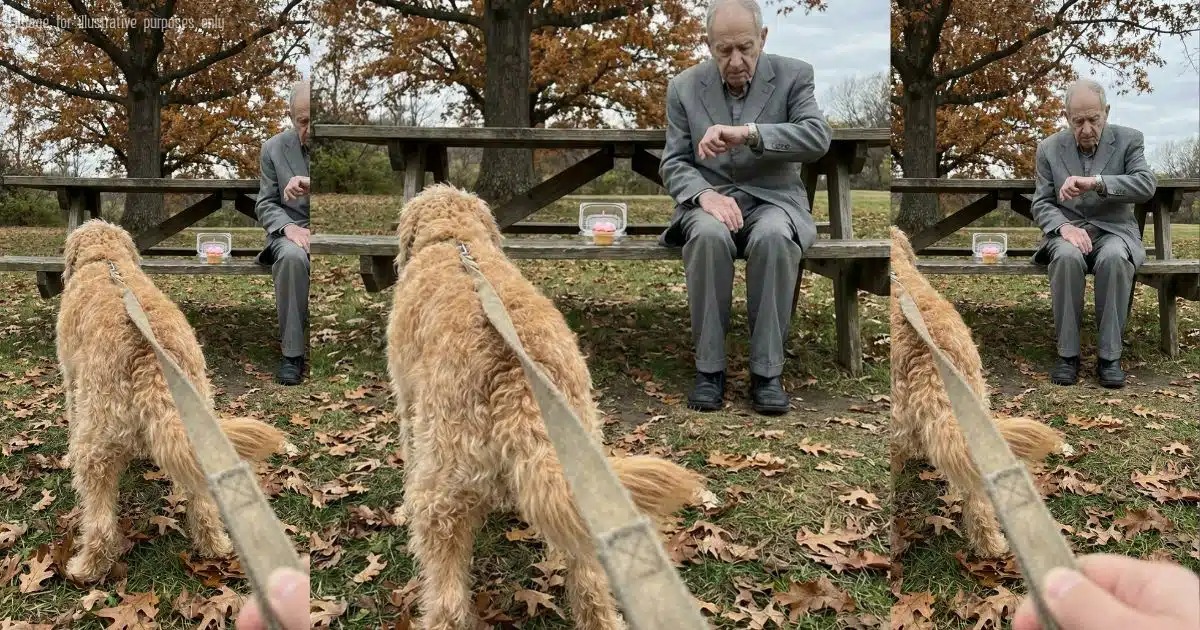
I followed his gaze across the empty lawn to a solitary wooden picnic table under an oak tree.
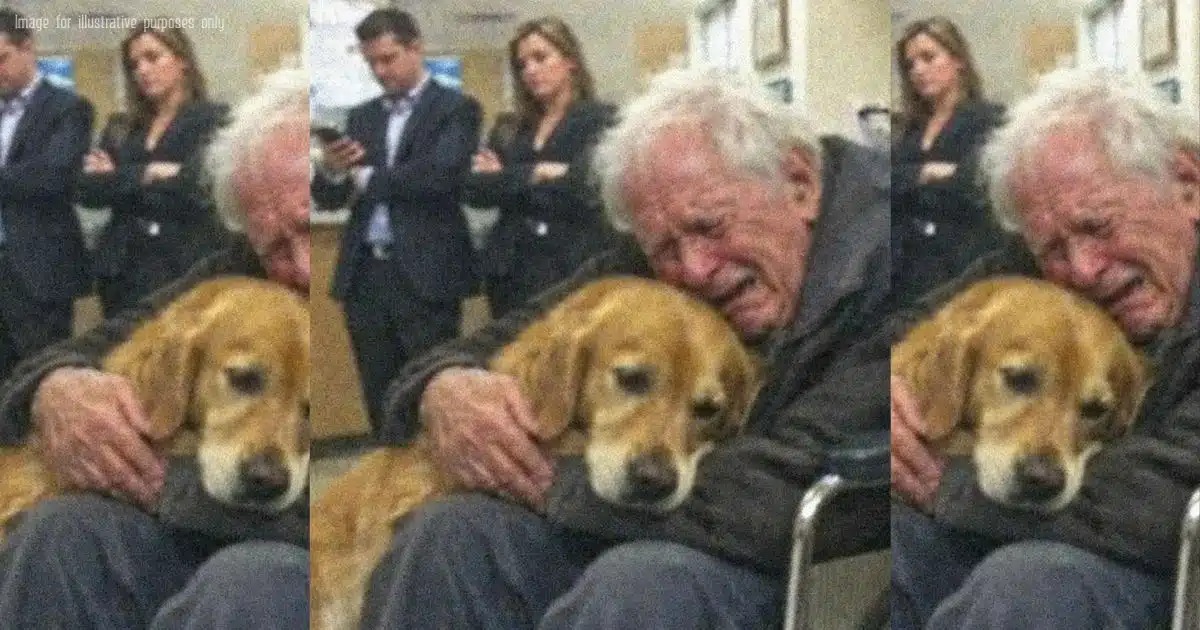
Sitting there was an older gentleman. He was dressed in a pressed Sunday suit that looked a decade out of style but immaculately kept. His posture was rigid, military-straight, but his head was bowed.
And then I saw it.
In the middle of the large, empty table, there was a small plastic container. Inside sat a single grocery-store cupcake with pink frosting. Beside it lay a single, unlit birthday candle.
He checked his watch. Then he looked at the parking lot. Then he checked his watch again.
My chest tightened. I knew that look. It’s the look of someone bargaining with reality, hoping that “late” doesn’t mean “forgotten.”
“Buddy, let’s not bother him,” I whispered to Rigby, feeling that awkward human urge to give people privacy, even when they’re drowning in it.
Rigby ignored me. He barked once—sharp and demanding—and pulled. hard. The leash slipped from my cold fingers before I could tighten my grip.
“Rigby! No!”
I took off running, terrified my goofy rescue dog was about to jump on a fragile old man in a nice suit.
But Rigby didn’t jump.
He trotted right up to the bench, slowed down, and sat. Then, with a gentleness I didn’t know he possessed, he laid his heavy, blocky head right on the stranger’s knee.
The man flinched. He looked down, startled, pulling his hand back.
I reached them, breathless. “I am so sorry, sir! He slipped the leash. He’s usually not this intrusive. Rigby, get over here!”
I reached for the collar, but the man raised a trembling hand to stop me.
“It’s… it’s okay,” the man said. His voice was like dry leaves. “He’s warm.”
The man buried his fingers into Rigby’s neck fur. Rigby closed his eyes and let out a long, contented sigh, leaning his entire body weight against the man’s leg.
“He used to be a stray,” I found myself saying, the adrenaline fading. “He has a weird sense for people. He usually ignores everyone at the park. If he chose you, sir, it means you’re the most important person here.”
The old man looked up at me. His eyes were rimmed with red, swimming with tears he’d been holding back for hours.
“I’m Arthur,” he choked out.
“I’m Jack. And this is Rigby.”
Arthur looked back at the empty parking lot one last time. The hope finally died in his eyes, replaced by a crushing acceptance.
“My son and his family were supposed to meet me,” Arthur said, his voice barely a whisper. “Big promotion at work. Grandkids have soccer. I suppose… I suppose life just got in the way.”
He looked at the cupcake. “I turned eighty today.”
The silence that followed was heavier than the gray sky above us.
I looked at Arthur. I looked at the pathetic little candle. Then I looked at Rigby, who was refusing to leave this man’s side, offering the only gift he had: his presence.
If my dog could be that brave, I could step up too.
“Well, Arthur,” I said, stepping over the bench and sitting opposite him. “I hope you don’t mind crashing your party. I skipped lunch, and that frosting looks pretty good.”
Arthur blinked. “You… you want to stay?”
“I’m not leaving until we sing,” I said, patting my pockets until I found my lighter. “And Rigby loves cake. It’s his weakness.”
A slow, disbelief-filled smile cracked the sorrow on Arthur’s face.
I lit the candle. Original work by Pawprints of My Heart. The tiny flame danced in the wind, fighting the gloom.
“Happy birthday to you…” I started, my voice cracking a little.
Arthur joined in, whispering the words. And then, as we hit the final note, Rigby threw his head back and let out a long, melodious howl that echoed across the empty park.
Arthur laughed. It was a rusty, unused sound, but it was real. He blew out the candle.
We sat there for an hour. We split the cupcake three ways (Rigby got the bottom half, no chocolate). Arthur told me about his late wife, about his time in the Navy, and about the yellow house he built with his own hands. He told me he hadn’t touched a dog in five years since his old Beagle passed away.
“I felt invisible when I sat down here,” Arthur told me as we finally stood up to leave. He brushed a crumb off his lapel. “I felt like I had outlived my usefulness to the world.”
He reached down and scratched Rigby behind the ears one last time. Rigby thumped his tail against the leg of the picnic table.
“But you two saw me,” Arthur said, gripping my hand with surprising strength. “You stopped. You have no idea what that means.”
“Happy birthday, Arthur,” I said.
I watched him walk to his old sedan. He walked a little taller than before. He waved as he drove away.
I sat in my truck for a long time before turning the key. Rigby was already asleep in the passenger seat, his job done.
I looked at my phone. I scrolled past the sports updates and the news alerts until I found “Mom.” I hadn’t called her in two weeks. I was “too busy.”
I hit dial.
“Hey, Mom,” I said when she picked up. “No, nothing’s wrong. I just… I really wanted to hear your voice.”
Don’t ignore the empty chairs. Don’t assume someone else will stop. Sometimes, it takes a dog to teach us that the greatest gift isn’t what you buy—it’s just showing up.
Part 2
I thought that phone call to my mom would be the ending.
A small, decent ending. The kind you tuck into your pocket like a warm stone—proof you still have a heart in there somewhere.
But life doesn’t hand you clean endings.
It hands you a dog who won’t move, an old man with a single candle, and then—just when you think you did your good deed for the week—it hands you the mess that comes after “showing up.”
Because showing up is easy for an hour on a cold Sunday.
Showing up when it gets complicated?
That’s the part nobody posts.
My mom answered on the second ring like she’d been holding the phone.
“Jack?” Her voice was bright in that way people get when they don’t want to sound as lonely as they are.
“Hey, Mom.” I tried to keep it casual, like I hadn’t been sitting in my truck staring at my contacts list for ten minutes. “You busy?”
A soft laugh. “I’m watching a cooking show and yelling at the contestants like they can hear me. So, no.”
Rigby snored in the passenger seat, mouth slightly open, one paw twitching like he was chasing something in a dream. His fur still smelled faintly like park wind and old cologne.
I swallowed. “I just… wanted to hear your voice.”
There was a pause, and I could picture her in her little kitchen, the one with the faded floral curtains, her hand pressed to her chest like she’d just been surprised by a kindness she didn’t think she deserved.
“Well,” she said softly, “that’s the nicest thing I’ve heard all week.”
We talked for twenty minutes about nothing and everything—her neighbor’s cat that kept using her flower bed like a litter box, the leak under her sink she kept ignoring, the way her knee got stiff when the weather changed.
She didn’t say, It’s been two weeks. She didn’t say, You only call when you feel guilty.
My mom has always had a way of loving you so gently it hurts.
When I hung up, I sat there a moment with the phone still warm in my hand, staring through the windshield at the empty parking lot.
Rigby lifted his head, blinked at me, and thumped his tail once, like: Good. Now do it again tomorrow.
The next day, I couldn’t stop thinking about the cupcake.
Not the frosting. Not the candle.
The way Arthur checked his watch like time was something he could bargain with.
Tuesday, on my lunch break, I found myself turning into the same park.
It was colder. The sky had that dull, metallic look like it was tired of holding itself up. The picnic table under the oak tree was empty.
Rigby dragged me toward it anyway, nose down, pulling like there was a scent trail made of sadness.
I stood there, hands shoved into my jacket pockets, feeling stupid.
What did you think was going to happen? I told myself. That he’d be waiting for you? That you’d become part of his routine after one hour?
But Rigby sniffed the bench, circled once, and sat with his back straight, staring at the parking lot like he was on duty.
My throat tightened.
I looked at the table. No cupcake this time. Just a dark ring on the wood where a plastic container had sat.
I pulled out my phone and opened my notes app, thumb hovering.
I didn’t have Arthur’s number. Didn’t even know his last name.
All I had was an image: a pressed suit, trembling hands, eyes rimmed red.
And a dog who refused to accept that as a one-time encounter.
On my way out of the park, I stopped at the small bulletin board near the bathrooms where people pinned flyers for lost cats and guitar lessons and tutoring.
Someone had taped up a neon orange sheet of paper.
VETERANS COFFEE HOUR — THURSDAYS 10AM
COMMUNITY CENTER (ON MAPLE)
ALL WELCOME
I stared at it like it was fate.
Rigby barked once, sharp, as if to say: Yes. That. Go.
Thursday morning I took a personal day.
I told my boss I had “an appointment.” Which was true, in a way. An appointment with my own conscience.
The community center smelled like old carpet and weak coffee. Folding chairs formed a loose circle. A handful of men sat in silence, their faces carved into that familiar shape life gives people who’ve seen too much.
Rigby walked in like he owned the building.
Heads turned.
A woman behind a table looked up, smiling automatically—until she saw Rigby’s size.
“Service dog?” she asked, polite but cautious.
“No,” I admitted. “Just… a dog who’s better at being a human than I am.”
She blinked. Then her smile softened. “We’ve had worse.”
Rigby trotted forward, scanning faces with that calm intensity he’d had at the park.
And then I saw him.
Arthur.
Same pressed suit. Same military-straight posture.
Different expression.
He looked less like he was shattering and more like he’d already shattered days ago and was now trying to glue himself back together using routine.
He noticed us, and for a second his whole face changed—like someone had opened a window in a stuffy room.
“Jack,” he said, sounding genuinely surprised. Like he hadn’t let himself expect to see me again.
“Arthur.” I exhaled like I’d been holding my breath since Sunday. “Rigby made me.”
Rigby went right to him, no hesitation, and rested his head on Arthur’s knee like that spot had been reserved.
Arthur’s hand trembled as he scratched behind Rigby’s ears. His eyes shone, but he blinked hard like he hated his own tears.
“I didn’t think…” he started, then stopped.
“You didn’t think I’d show up again,” I finished quietly.
Arthur gave a small, embarrassed shrug. “People say things when they’re being kind.”
I sat down across from him, the folding chair squeaking. “I’m not good at saying things.”
“No?” Arthur’s mouth twitched, a ghost of a smile.
“I’m better at… this.” I gestured at the room, at the coffee, at my awkward presence. “At being here.”
Arthur stared down at Rigby. “So am I,” he whispered, like a confession.
For a while we just listened to the murmur of other conversations. Stories about knees that didn’t work, about grandkids who lived in another state, about jobs that used to matter until they didn’t.
Arthur leaned toward me, voice low. “You ever feel like… you could disappear for a week, and the only one who’d notice is your dog?”
I laughed once, but it came out rough. “Yeah.”
He nodded slowly, as if that answer meant something important.
Then he surprised me.
“I told my son about you,” Arthur said.
My stomach dropped. “You did?”
Arthur’s gaze stayed on the floor. “I didn’t mean to. It just… came out.”
“What did you say?”
“I said,” Arthur swallowed, Adam’s apple bobbing, “that a stranger and a dog sang to me when my own family didn’t show.”
I opened my mouth, then closed it, because there was nothing to say that didn’t feel like stepping on a landmine.
Arthur exhaled shakily. “He got quiet. Real quiet. The kind of quiet that’s either guilt… or anger.”
“And which was it?”
Arthur’s smile was thin. “Both.”
After coffee hour, I walked Arthur to his car.
The old sedan looked even older in the pale winter sun. Arthur moved carefully, like his joints had an opinion about every step.
He patted his pockets, then frowned.
“Keys?” I asked.
Arthur’s face tightened. “Must’ve left them inside.”
“I’ll grab them,” I said automatically, already turning back toward the building.
“Jack,” Arthur called, and there was something in his voice that stopped me.
I turned.
Arthur stood there with his hands clasped in front of him like a man waiting for judgement.
“You don’t have to do this,” he said. “Whatever this is.”
I stared at him. “Do what?”
“Make me… matter.” His voice cracked on the last word. He looked away fast, like he was ashamed of needing anything.
Rigby pressed against Arthur’s leg, steady as a pillar.
I felt something hot behind my eyes.
“I’m not making you matter,” I said quietly. “You already do. I just… didn’t want you sitting alone again.”
Arthur let out a breath that trembled. “My son thinks it’s… strange.”
“That I showed up?”
“That you care,” Arthur said, and the way he said it made it sound like caring was the suspicious part.
I swallowed. “What’s your son’s name?”
Arthur hesitated. “Kevin.”
“And… is Kevin dangerous?” I asked carefully. “Or just… busy?”
Arthur’s mouth tightened. “He’s not dangerous. He’s a good man. He’s just… overwhelmed. And proud. And he doesn’t like the idea that someone saw him fail.”
There it was.
Not just loneliness.
Shame.
The thing nobody admits is sitting at the table with the cupcake too.
I nodded slowly. “People get mean when they’re embarrassed.”
Arthur’s eyes flicked up to mine. “The internet gets mean,” he corrected.
I blinked. “What do you mean?”
Arthur’s lips pressed together. “Kevin’s wife… she posted about it.”
My skin went cold. “Posted about what?”
Arthur looked genuinely pained. “About how some ‘random guy’ and his dog ‘inserted themselves’ into a private family situation.”
My heart kicked hard against my ribs.
“I didn’t—” I started.
“I know,” Arthur said quickly. “I know you didn’t. But she has friends, and they have opinions, and suddenly…”
He trailed off, staring at the community center door like it might explode.
“Suddenly what?” I asked, already dreading the answer.
Arthur’s voice dropped to a whisper. “Suddenly I’m a story.”
That night I made the mistake of searching my own name.
Not even my full name. Just “Jack” and the park. Just curiosity, the way you poke a bruise to see if it still hurts.
And there it was—screenshots of a post in a local group I didn’t belong to.
No brands. No platform names. Just the familiar layout of a comment section I’ve seen a million times.
A blurry photo—taken from a distance—of Arthur at the picnic table.
Rigby’s head on his knee.
Me sitting across from him, lighter in hand.
Someone had zoomed in and circled Arthur’s face like he was evidence.
“My father is being targeted by strangers at the park.”
“He’s vulnerable and these people are exploiting him.”
“If you see this man with my dad, please message me.”
My mouth went dry.
Rigby lifted his head from his bed and looked at me, ears perked like he felt the shift in my heartbeat.
I scrolled, and my stomach sank deeper with every comment.
Some people were furious on Arthur’s behalf.
“That’s heartbreaking. Someone should check on him.”
“How could his family forget his birthday?”
“Adult kids are selfish.”
“This is why we need to care for our elders.”
Others were furious at me.
“Why is a stranger sitting with an old man? Creepy.”
“Performative kindness is still performance.”
“If you really cared, you wouldn’t take photos.”
“This feels like a setup.”
And then the worst ones—the ones that always show up like flies.
“Maybe the old man drove his family away.”
“You don’t know the full story.”
“Some parents are toxic. Nobody owes them.”
“Stop shaming families.”
I stared at that last one for a long time.
Because it hit a nerve.
Because part of me wanted to shout, He was just sitting there with a cupcake. How toxic can that be?
And another part of me—the part that’s lived long enough to know better—whispered, You don’t actually know.
I didn’t know Arthur’s entire history.
I didn’t know what Kevin carried.
I only knew what I saw: an empty chair.
And a dog who refused to walk away from it.
My phone rang at 9:17 p.m.
Unknown number.
I hesitated, thumb hovering over decline.
Rigby stood, tail low, eyes on me like he was bracing.
I answered.
“Hello?”
A man’s voice, tight and controlled. “Is this Jack?”
My spine went rigid. “Yes.”
A breath, sharp. “This is Kevin.”
The room went silent except for Rigby’s nails clicking softly on the floor as he paced.
“You’re Arthur’s son,” I said.
“Yes.” Kevin’s voice sounded like it had been sanded down by exhaustion. “And I’m calling because I’d like you to stop.”
I closed my eyes. “Stop what?”
“Seeing my father.” The words came out clipped, like he’d rehearsed them. “Stop inserting yourself into his life. Stop—”
“I didn’t post anything,” I cut in before I could stop myself. My voice rose, heat flaring. “I didn’t take that photo. I didn’t ask for this.”
Kevin’s silence crackled through the line.
Then he said, quieter, “I know.”
That single sentence took the fight right out of me.
I swallowed. “Then why are you calling me?”
“Because,” Kevin exhaled, and for the first time he sounded human, not like a man reading from a script, “my wife is terrified.”
“Of me?”
“Of what this looks like.” His voice tightened again. “Of strangers. Of people contacting us. Of our kids seeing comments. Of my father being talked about like he’s… entertainment.”
I rubbed my forehead. “I didn’t want any of that.”
“I believe you,” Kevin said, and it sounded like it cost him something to admit it. “But you have to understand—my dad… he’s private. He’s proud. He doesn’t ask for help.”
“He shouldn’t have to ask to not be alone on his birthday,” I snapped, immediately regretting it.
Kevin went quiet again.
When he spoke, his voice was rough. “Do you think I don’t know that?”
The anger in my chest faltered.
Because there was guilt in his tone, thick as mud.
“I’m not calling to fight,” Kevin said. “I’m calling because this has turned into something… ugly. And my dad is caught in the middle.”
I stared at my dark TV screen, my own reflection looking back like a stranger.
“What do you want me to do?” I asked.
Kevin hesitated. “I want you to… back off. Give us space.”
“And if your dad sits alone again?” I asked, voice low. “If he checks his watch again and hopes doesn’t show up?”
Kevin’s breath hitched like I’d punched him.
“You don’t know our life,” he said, softer now. “You don’t know what we’re dealing with.”
“Then tell me,” I said before I could think. “Because right now, the whole town is telling a story about you, and you’re letting them.”
Kevin let out a bitter laugh with no humor. “You think I can control the internet?”
“No,” I admitted. “But you can control your own choices.”
Silence.
Then Kevin said, so quietly I almost didn’t hear it, “My dad wasn’t always… easy.”
I froze.
Kevin continued, words coming slow, like he was walking barefoot over broken glass. “He loved us. He provided. But he was… hard. Everything was discipline. Everything was ‘toughen up.’ When my mom died, he shut down. He didn’t grieve with us. He grieved at us.”
My throat tightened.
“And now?” I asked.
“Now he’s eighty,” Kevin said, voice cracking just slightly. “Now he looks small. Now he looks like someone I’m supposed to protect. And I don’t know how to be that for a man who raised me to never need anyone.”
I sat down hard on the couch.
Rigby came over and pressed his head into my thigh, grounding me.
Kevin’s voice broke a little more. “Sunday was supposed to be simple. Cupcake. Candle. The kids had a game. I had… something at work. We were going to be late, but we were going.”
“You didn’t show,” I said, not accusing now—just stating.
Kevin exhaled shakily. “There was a fight in the car. My daughter threw up on herself. My son started screaming that he didn’t want to go at all. My wife snapped at me. I snapped back. We pulled into a gas station and just… sat there. Everyone mad. Everyone exhausted.”
His breathing sounded uneven.
“And then,” Kevin said, “I looked at the clock and realized… we weren’t just running late. We were choosing.”
The word landed heavy.
“We turned around,” Kevin admitted. “We went home.”
I stared at the ceiling, trying to imagine that moment: the car full of noise and stress, and the quiet decision sliding into place like a door closing.
“Did you call him?” I asked.
Kevin’s voice turned hollow. “No.”
I closed my eyes. “Kevin…”
“I know,” he whispered. “I know. And now the whole town knows.”
He inhaled sharply. “My wife made that post because she thought—if we could find you, we could make it stop. Like you were the problem.”
“I’m not,” I said quietly.
“I know,” Kevin repeated. “But you’re… proof.”
Proof.
That someone else could do in an hour what his own family didn’t do at all.
I let out a slow breath. “What does Arthur want?”
Kevin was silent for a long time.
Then he said, voice small, “He wants to pretend it didn’t hurt.”
My chest ached.
“And what do you want?” I asked.
Kevin’s voice cracked fully then. “I want my dad to stop looking at me like I’m a stranger.”

Leave a Reply