
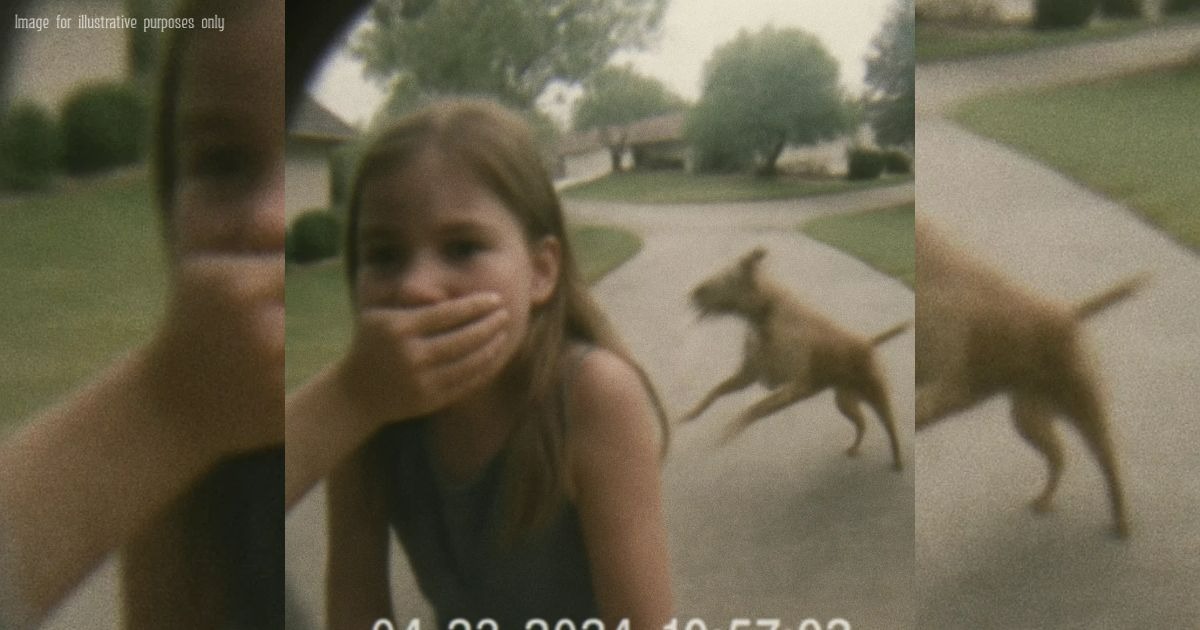
My daughter’s scream cracked the sunny Sunday air, and our pit bull reached her before I did—two heartbeats, one blur of tan muscle, then everything went still.
I was frosting a sheet cake in the kitchen, the kind you take to church and hope comes back empty, when it happened. The back door was open to let in the breeze, and I could hear the soft scrape of chalk on concrete. June was drawing galaxies on our driveway—purple spirals, shooting stars with too many tails. Daisy lay nearby, chin on paws, every inch of her a watchful sigh.
“Mike,” I called to my husband over the mower’s hum, “don’t scalp the rye again.”
He waved without looking and kept mowing straight lines, neat as ledger paper. It was ordinary, right down to the neighbor boy’s sneakers squeaking through the side gate. Evan. He comes and goes like boys do in this neighborhood—no one locks anything but their politics around here.
“Hi, June,” I heard him say. “Can I help?”
“Sure,” she murmured, shy but kind. She always is.

Then the scream. A ripping sound in the day. I dropped the spatula, frosting smearing my knuckles, and vaulted the threshold, my body moving before my thoughts caught up. By the time I hit the patio, Daisy had left her spot—crossed the three yards of concrete with a precision that felt like a miracle and a nightmare—wedgeing her body between my little girl and the boy.
I saw three things at once: June’s eyes, wide and watery; Evan’s face, pale and surprised; Daisy’s stance—low, steady, a living barricade. There was a scuffle, a tangle, and then Daisy’s head snapped. It wasn’t wild. It wasn’t frenzied. It was a quick, decisive correction, the way a mother dog tells a pup that enough is enough. Evan yelped and jerked his hand back, stumbling to the grass.
“Daisy!” I shouted, already hauling my daughter into my arms. June’s breath came in quick, shallow sips. “Honey, are you hurt?”
She shook her head hard, then pressed her face into my shirt. “I said stop,” she whispered, so small I almost missed it. “I said stop, Mom.”
Mike killed the mower and sprinted over. Evan cradled his wrist, not bleeding badly, but rattled. His voice climbed into that place between anger and fear. “Your dog attacked me! She’s dangerous!”
Our neighbors appeared as if the fence line had learned to grow people. Phones were in hands before anyone asked if the kids were okay. Someone said “pit bull” like it was a curse. Someone else said “call Animal Control” like it was mercy. I called 911 because that’s what you do when things get bigger than you are.
Daisy had already backed away, tail low, licking her lips in the dog version of apology, then sitting beside June as if she had been nailed there. She leaned into my girl’s knee, eyes flicking from me to Evan and back, waiting for whatever came next.
What came next was a lot of official language. Officer Ortiz from Animal Control arrived in a crisp uniform and voice that mattered. He examined Evan’s wrist—superficial, thank God—and asked me what happened. I said the words I could say: “There was a scream. A scuffle. Daisy inserted herself. She’s always gentle. She’s… protective.” My mouth filled with the coppery taste of the word.
From the sidewalk, Evan’s father, Rick, found his own volume. “That dog should be put down,” he shouted, two steps away from the line he probably wished he wouldn’t cross later. “My son came over to play.”
Officer Ortiz’s face didn’t change. He explained the procedure: ten-day quarantine, standard observation. “It’s not a judgment,” he said to me, kindness contained in a professional shape. “It’s the law.”
June clung to Daisy’s collar and Daisy didn’t move, not once, not even when the leash came out. “It’s okay,” I told my daughter. “We’ll bring her home soon.” I told myself too. Daisy rose, head dipped, as if apologizing for a job that needed doing. I signed the form. Ortiz walked her to the truck, and I felt the day tip, light sliding off the plate of it.
Inside, I washed my hands three times and couldn’t get rid of the frosting tackiness. Mike called Tanya, Evan’s mom, who sounded mortified and scared in equal measure. She promised to take Evan to urgent care “just to be safe.” We promised to pay whatever needed paying. It was the ordinary choreography of an extraordinary moment.
After the house emptied of outrage and officialdom, the quiet sat down with us. June curled on the couch under the old quilt my mother sent when we moved here. The chalk galaxies lay abandoned on the driveway, a smudge of purple rain. I tucked hair behind June’s ear. “What happened?” I asked, making each word a soft thing she could pick up or set down.
She swallowed and stared at the TV stand, not the TV. “I said stop,” she repeated. “I said it two times.” Her fingers pressed crescents into the fabric. “He didn’t stop.”
I felt something inside me rehearse fury and then fold itself into caution. Words matter when you’re a parent and the world is listening. “Thank you for telling me,” I said. “You did the right thing saying stop.”
That night, after Mike went to fix the side gate latch that suddenly felt flimsy as paper, I remembered the doorbell camera, the smart little eye that catches porch pirates and dropped packages and sometimes the truth. I didn’t want to look. I looked anyway.
I scrolled to the hour stamped in a neat digital font. The clip loaded. There was our driveway in bright, ordinary sunshine. There were the chalk galaxies, the chalk dust on June’s knees. Evan stepped into frame, sneakers skidding a little. They spoke, but the camera doesn’t do sound that far away; it just records the theater of bodies.
I watched June draw a line and Evan reach. I watched her pull back. I watched him lean in.
And then I saw it—just a flicker, just enough: a small hand rising, covering my daughter’s mouth.
The frame jumped with motion—Daisy launching like a prayer—and the video froze on its auto-pause, asking if I wanted to keep watching.
Part 2 — Twelve Seconds and Ten Days
The doorbell app said the clip was twelve seconds. I made myself watch it three times before I hit “share.” No sound, just the choreography of bodies: Evan stepping into our driveway like any other day; June’s knees powdery with purple chalk dust; his hand reaching; her flinch; his hand again; that small palm rising to cover my daughter’s mouth; Daisy launching like a muscle fired from a quiet heart.
I texted the clip to Officer Ortiz with a note that read: Please add to your report. We want to follow the law. We also want the truth. He replied within minutes—short, precise. Received. Logged. Thank you. Then, a second bubble: This helps context. Quarantine still required.
The word quarantine hung in our kitchen like a smell. Ten days. Observation. Not punishment, just policy. I said that out loud to June, to Mike, to myself—like if I said it enough, it would sand down the edges.
The next morning, we drove out to the city shelter where Animal Control held observation cases. It’s a low, clean building behind the public works yard—smells like bleach and hope, sounds like metal doors and dogs learning the script of patience. Ortiz met us in the lobby with coffee breath and steady eyes.
“Leah,” he said, and shook my hand like we were already on the same team, because maybe we were. “Thank you for sending the footage.”
“It doesn’t solve everything,” I said, “but it solves the part where people say she’s a monster.”
“Monsters don’t sit down before they’re leashed,” he said. “She did.”
He walked us down a corridor lined with kennels, each with a laminated sheet clipped to the door: intake time, vaccination status, temperament notes. When we reached Daisy’s run, she was lying on a blue cot, chin parked on the edge like she’d been waiting for our footsteps. Her tail thumped once, twice, then she caught herself—looked from me to Ortiz, asking with her eyes if the rules allowed joy.
“You can’t enter the run,” Ortiz said, gentle but firm. “No touching through the bars. It’s not personal. We follow the same rules for every case.”
I knelt anyway, inches from the gate, and talked to her the way you talk to a baby who hasn’t learned words yet. “Hey, girl. We’re okay. You’re okay. We’re doing the boring, right thing.”
Daisy licked the air, the gate, anything that got her closer without breaking a rule. June pressed her palms to the bars and whispered, “I miss you,” and Daisy made that low, content sound that lives somewhere between a hum and a purr.
Ortiz wrote something on his clipboard. “She’s eating. No signs of agitation. Staff notes say she’s responsive to cues. We’ll complete a full behavior eval on day three.”
“Will the video change how she’s labeled?” Mike asked from behind me. His voice had that careful flatness he uses when he’s working on an engine: keep it steady, don’t crack any bolts.
“It provides context,” Ortiz said. “We classify bites along a spectrum, and we consider whether a dog intervened in a stressful human situation. I can’t make promises, and I don’t want to get ahead of the process. But you did the right thing by sharing it.”
On the way home, we stopped for drive-thru pancakes because grief makes you feed people. June ate from the paper tray in the back seat and asked, without looking up, “Is Evan mad at me?”
I told the truth I could carry: “He’s scared and embarrassed. Scared makes people loud. Embarrassed makes them point.”
At the kitchen table, Mike wanted to post the video. “The neighborhood group is a bonfire,” he said, scrolling. “People are calling her ‘that pit.’ Like using her name would cost them something.”
“I know,” I said. “But if we post it, we don’t control the story. We’ve seen what happens to stories when they go for a walk on Facebook.”
He rubbed his thumb over a nick in the table he’d meant to sand months ago. “So we do what?”
“We choose a grownup,” I said. “Someone who’ll tell the whole thing instead of picking a side and sharpening it.”
That afternoon, I sent a message to a local reporter, Rosa Chen, who once wrote a piece about our food bank without making anyone the hero or the villain. We don’t want a spectacle, I typed. We want a conversation. If you’re willing to tell a complicated story, we’ll talk. If you want something simple that will burn hot and die fast, we’re not your people.
She called within an hour. Her voice was low, the kind you’d want reading you the news at midnight. “Complicated is my love language,” she said. “Send me what you have. I’ll verify everything and talk to everyone.”
Before dinner, Tanya—Evan’s mom—texted me. We’re at urgent care. They say it’s superficial. He’s embarrassed. I am too. I’m sorry about Rick’s yelling. He’s… loud when he’s scared. I stared at that sentence until the words lost shape. Loud when he’s scared. A lot of men are. A lot of women too, if we’re honest.
Thank you for telling me, I texted back. We’ll pay his bill. We want to find a way through this without making it worse for the kids.
She asked if I could send the video. I hesitated, then did. There are moments you decide to trust, and then you get to keep living with yourself later.
Rosa’s article went online that night. The headline didn’t shout. “When a Dog Hears ‘Stop’: A Neighborhood Revisits Safety.” She didn’t name the kids. She explained the ten-day quarantine like a recipe: measured steps, no room for rage. She spoke to Ortiz about policy, to a trainer about canine body language, to a school counselor about teaching kids to set and respect boundaries. Our street looked less like a courtroom and more like a class we might pass if we took notes.
It didn’t stop the bickering on the neighborhood group, but it changed the key. The chorus shifted from “ban the breed” to “teach the boundary.” People posted pictures of their own dogs babysitting toddlers and teenagers alike, and under each one, someone wrote: Our dog doesn’t replace parenting. She just reminds us to pay attention.
That night, the house felt hollow without Daisy’s nightly patrol—her ritual of checking doors, noses to ankles, the final thump against the couch before sleep. June put Daisy’s favorite rope on the coffee table like a place setting. Mike scrolled through the home security app again, like somewhere between camera angles there might be a frame where this whole thing didn’t happen.
I logged into our pediatrician’s portal to schedule an appointment for June. My hands did the practical work—birthdate, checkboxes, preferred time—while my mind wandered the hard questions: How do you help a child feel safe without teaching her to be afraid of everything? How do you talk about what happened without putting words in her mouth that don’t belong there?
I hit “submit,” and the screen refreshed into a list of messages—old lab reminders, vaccination confirmations, a digital echo of a growing child. One new message blinked at me: Clinical Note Added. I clicked.
It wasn’t from today or yesterday. It was from ten days ago. The sender: School Nurse (Forwarded via District Health). I felt my ribs tighten like fingers.
The note was short, professional, the way nurses’ notes are—no poetry, just truth: Observed faint bruising around left wrist during recess complaint of tenderness. Student stated, “It’s fine.” No swelling at time. Advised to monitor. Parent contact attempted; voicemail left.
Below it, a thumbnail photo taken for the record—not to shame, just to document. The kind of picture that’s more shadow than shape. A small wrist. A faint yellowing band where fingers might have been. The date stamp sat in the corner like a quiet witness.
My phone buzzed with a text from Rosa: Town hall next week on “Safe Play, Safe Pets.” Councilwoman Monroe wants Animal Control and a child therapist there. Interested?
I read the message and then read the note again, the way you reread a recipe to see what you missed the first time. Somewhere outside, someone’s wind chimes tried to make a song out of a restless night.
I called Mike into the room and pointed at the screen. He leaned over my shoulder, breath held.
“That was before Sunday,” he said, voice low.
“Ten days,” I said. “Someone tried to tell us. We didn’t hear it.”
He pressed his thumb into that old nick in the table until his nail went white. “We hear it now.”
The portal chimed—a follow-up notification I hadn’t seen. Per school policy, documentation forwarded to primary care. Flag: follow-up recommended.
I clicked the attachment and the screen filled with clinic letterhead and careful language, the kind that keeps everybody calm while pointing at the thing that matters.
Assessment: Faint contusion, left wrist. Pattern suggests grip. Consider discussion on personal boundaries and safe touch.
I didn’t feel the chair underneath me for a second. The words didn’t accuse; they invited responsibility. They were a map I didn’t want, delivered to a place I couldn’t ignore.
In the quiet, June’s voice fluttered from the hallway. “Mom?”
I closed the laptop. “Yeah, baby.”
“Can Daisy come home tomorrow?”
I swallowed around the truth and made it simple. “Not tomorrow. But soon. And meanwhile, we’re going to talk to some kind helpers who know about keeping kids safe.”
She nodded, as if she’d expected both parts—the wait and the helpers. Then she reached for my hand and traced a circle on my palm, the way she does when she’s trying to say something without saying it.
“What’s that mean?” I asked.
“It means stop,” she said.
When she slept, I opened the laptop again, the screen still on the note, the photo, the stamp. I knew what came next: calls, meetings, more careful words. I also knew I had to send this to Ortiz, to Rosa, to Tanya even—because the story couldn’t fix what happened, but it could stop a worse version from happening again.
My cursor hovered over the “forward” button. I clicked.
And as the message went out—to the officer, to the reporter, to the mother next door—the portal pinged once more, a new bubble opening like a held breath:
New message: Provider Review Completed. Recommended referral: Child therapist, boundary and body-safety education.





Leave a Reply