
Part 1: The Last Frequency
They forced me to put my healthy dog down today. But seconds before the needle touched him, the radio screamed a message from the dead.
The vet’s hand was shaking. Mine wasn’t.
“Mr. Vance, are you sure?” Dr. Aris asked softly. “Once I push this plunger, there is no going back.”
I looked down at Barnaby.
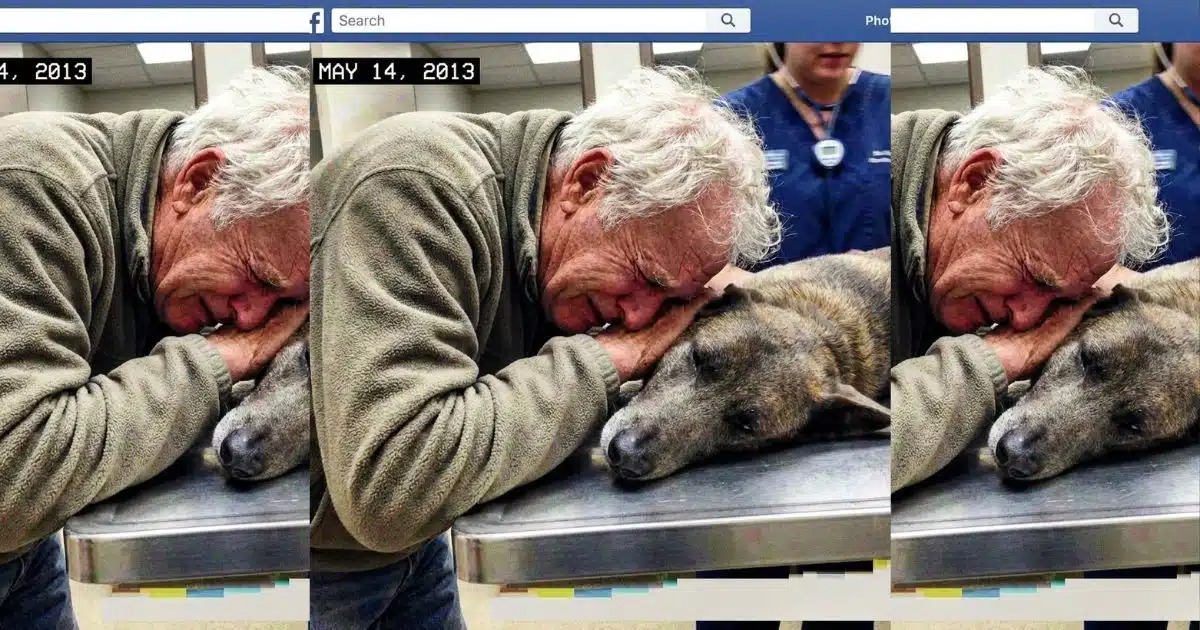
My fourteen-year-old Malinois. My shadow.
He was lying on the cold steel table, his one good eye clouded with cataracts. He thumped his tail once. Thump. A slow, heavy sound that echoed in the silent room.
“Do it,” I rasped. My voice sounded like grinding gravel. “The new assisted living facility doesn’t allow dogs over 20 pounds. The eviction notice is on my door. If I don’t do this… the county takes him to the shelter. They’ll kill him in a cage, surrounded by strangers.”
I gripped Barnaby’s paw. It was rough, calloused from years of running on deck, running on asphalt, running toward danger when I was too slow.
“Better he goes to sleep in my arms,” I whispered. “He’s a soldier. He deserves a soldier’s exit.”

Dr. Aris nodded. He uncapped the syringe. The liquid inside was clear. Deadly.
“Wait.”
I stopped him. I didn’t know why. My hand moved on its own.
I reached into my old, battered canvas jacket and pulled out the brick.
My shortwave radio.
It was older than the vet. Scratched chrome, a bent antenna, held together by duct tape and prayers.
“Ten minutes,” I told the doctor. “Give us ten minutes. We used to listen to the shipping channels every night. It calms him down.”
The doctor sighed, checking his watch. “Five minutes, Silas. The waiting room is full.”
He stepped out.
I clicked the dial. Click.
Static filled the small room. Hisss. Crackle.
White noise. The sound of the ocean when you’re a thousand miles from shore.
Barnaby didn’t move. His breathing was shallow. He was ready to go. He knew. Dogs always know when it’s the end.
I spun the dial slowly, hunting for a frequency that probably didn’t exist anymore.
“I’m sorry, buddy,” I choked out, tears finally burning my eyes. “I failed you. I fought for this country for thirty years, and I can’t even keep a roof over my dog’s head.”
The static whined.
Then, it happened.
Dit-dit-dit. Dah-dah-dah. Dit-dit-dit.
SOS.
Standard. Boring. Probably a prank.
But then the rhythm changed. It wasn’t random. It was fast. Sharp. Urgent.
… -.-. …. — … .. . .-. .-. .- …- .. -.-. – — .-. …
My heart stopped.
I knew that pattern. I hadn’t heard that specific rhythm in fifty years. It was the encryption code of the USS Archangel.
My old ship.
The ship that was decommissioned and scrapped in 1995.
“Impossible,” I whispered.
I looked at Barnaby.
The dog was no longer lying down.
The “dying” animal, the one too weak to walk up the stairs this morning, was standing.
His ears were pinned forward. His hackles—the fur along his spine—were standing straight up like a razor’s edge.
A low, guttural growl vibrated in his chest. It wasn’t a growl of pain. It was a growl of recognition.
The radio crackled again. A voice, buried under layers of atmospheric noise, cut through the room.
“…Sector 4… Chimera actual… The water is rising… Silas, are you there?”
My blood turned to ice.
The voice didn’t say “Is anyone there?”
It said Silas.
It was my name.
And I knew the voice. It belonged to a man who was supposed to be in a nursing home in Florida. A man who stopped writing to me six months ago.
Barnaby barked. A sharp, commanding bark that shook the medicine bottles on the shelf.
The door flew open. Dr. Aris rushed in, looking panicked.
“Mr. Vance! You need to keep him quiet! The sedative is ready, let’s just get this over with.”
He reached for Barnaby’s neck.
Barnaby snapped.
Teeth clacked inches from the doctor’s hand. The old dog placed his body between me and the vet, assuming a combat stance I hadn’t seen since he was a puppy.
“Get back!” I yelled at the doctor.
“Silas, you’re making this harder than it needs to be!” the doctor shouted, reaching for the phone on the wall. “I’m calling security. You’re distressed.”
I looked at the syringe on the tray. Then I looked at the radio. Then at my dog.
The voice on the radio came again. Louder. Desperate.
“…They are burying us. Don’t let them win. Over.”
Something inside me snapped. The part of me that was a tired, broke old man died right there.
I wasn’t a pensioner being evicted. I was a Chief Petty Officer. And I had a mission.
I grabbed the radio. I grabbed Barnaby’s leash.
“Don’t touch that phone,” I warned the doctor. My voice was steady. Cold.
“Silas, you can’t take him. The court order says—”
“To hell with the order.”
I kicked the rolling tray. It crashed into the wall, shattering the vial of lethal solution.
Barnaby didn’t limp as we ran. He trotted perfectly at my heel, eyes locked forward, guiding me out.
We burst out of the clinic doors and into the blinding afternoon sun. My rusted pickup truck was waiting at the curb.
As I threw Barnaby into the passenger seat and cranked the engine, I saw the vet running out with his phone to his ear. He was calling the police.
I didn’t care.
I turned up the volume on the radio. The signal was fading, but the coordinates were clear now.
They weren’t coming from the ocean.
They were coming from the forbidden construction zone on the edge of town. The place where they were building the new luxury condos. The place where my house used to stand.
I slammed my foot on the gas.
I had 15,000 dollars of debt, a warrant out for my arrest, and a dog that was supposed to be dead.
But for the first time in ten years, I felt alive.
Because someone was buried alive out there. And my dog was the only one who could find them.
Part 2: The Fugitive on Home Soil
I spent thirty years fighting for this country, only to become an enemy of the state in my own driveway.
The adrenaline from the vet clinic was fading.
In its place came the cold, hard ache of arthritis and reality.
My truck, a rusted beast from a bygone era, rattled down the coastal highway. The suspension groaned with every pothole, protesting just like my knees.
Beside me, Barnaby sat upright.
He shouldn’t have been able to do that.
An hour ago, he was a heap of tired fur, ready to cross the Rainbow Bridge. Now, he was scanning the horizon, his ears swiveling like radar dishes.
He wasn’t cured. I knew that.
His muzzle was still gray. His hip still clicked when he shifted weight.
But he had a job. And for a working dog, a mission is better than medicine.
The radio on the dashboard was humming low. The signal—that ghostly SOS from the Archangel—had faded into static as soon as we left town.
But I knew what I heard.
Silas.
My name.
I turned the truck onto the gravel road leading to my property. Or what was left of it.
Once, this road was lined with oak trees and small fishing cottages. It smelled of salt and pine.
Now?
It smelled of diesel and wet concrete.
The oaks were gone, replaced by “Coming Soon” signs featuring smiling, diverse families who didn’t exist.
The cottages were bulldozed, replaced by the steel skeletons of luxury condos that looked like giant glass cages.
My house was the last one standing.
A small, weather-beaten wooden cabin perched on a bluff overlooking the Pacific. The paint was peeling. The roof sagged.
To the developers, it was an eyesore. A “blight.”
To me, it was the only place where I could still smell my late wife’s perfume in the closet.
I pulled into the driveway.
They were already there.
A sleek black sedan and a Sheriff’s cruiser.
“Damn it,” I muttered.
Barnaby let out a low growl.
“Easy, soldier,” I whispered, patting his head. “Stand down.”
I killed the engine. The silence was heavy.
Two men stepped out.
One was Deputy Miller. I’d known him since he was a chaotic teenager stealing traffic cones. Now he looked tired, his uniform straining at the waist.
The other man wore a suit that cost more than my truck. Sharp, blue, tailored. He was holding a tablet like a shield.
Mr. Sterling. The “Community Liaison” for the development company.
“Silas,” Deputy Miller said, keeping his hands visible. “Dr. Aris called. He said you caused a scene. Said you threatened him.”
I stepped out of the truck, leaving the door open for Barnaby.
“I didn’t threaten him, Miller. I just decided my dog wasn’t done living yet.”
Mr. Sterling stepped forward, his shoes crunching on the gravel. He smiled. It was a shark’s smile—all teeth, no warmth.
“Mr. Vance,” Sterling said, his voice smooth as oil. “We’re not here about the dog. Not really. We’re here about the… transition.”
He gestured to the house.
“The eviction notice was effective at noon today. We have a court order. Mental instability. Public endangerment. And now, fleeing a medical facility?”
He tapped his tablet.
“It paints a clear picture, Silas. You’re not safe to live alone anymore. The assisted living facility has a bed waiting. They have great pudding on Tuesdays.”
My hands clenched into fists.
“I’m not going to your warehouse for the dying,” I said. “And I’m not selling.”
“You already have,” Sterling said, his voice hardening. ” The eminent domain paperwork is filed. Your mortgage is underwater. We’re doing you a favor.”
Barnaby hopped out of the truck.
He didn’t bark. He just stood there. A silent, imposing statue of a dog.
He looked at Sterling.
Sterling took a step back. “I thought you said the dog was sick.”
“He got better,” I said.
“Silas,” Miller warned, his hand drifting near his belt. “Don’t make this a criminal matter. Just… come with us. Let animal control take the dog. It’s for the best.”
For the best.
That phrase.
They said it when they closed the shipyard. They said it when they denied my VA benefits. They said it when they buried my wife.
I looked at the radio in my hand.
It was silent.
But then, just as the sun dipped below the horizon, the speaker crackled.
Dit-dit-dit.
It was faint. Weak.
But Barnaby heard it.
He spun around, facing the north. Facing the massive construction site next door—the one surrounded by ten-foot fences and “DANGER: KEEP OUT” signs.
The site where my old neighbor, Tom, used to live.
Tom, who disappeared three weeks ago.
“He went to Florida to be with his sister,” Sterling had told me. “He’s happy.”
Barnaby barked at the fence. A sharp, questioning bark.
The radio hissed.
“…Oxygen… low… battery… dying…”
It wasn’t a hallucination.
“Did you hear that?” I asked Miller.
“Hear what?” Miller frowned. “It’s just static, Silas.”
They couldn’t hear it. Their ears were tuned to the noise of the world—money, laws, traffic.
They couldn’t hear the frequency of the left behind.
“Get off my property,” I said, my voice low.
“Mr. Vance, if you don’t comply—” Sterling started.
I reached into the truck bed and pulled out a tire iron.
“I said, get off my land. It’s private property until the Sheriff puts cuffs on me. And Miller, you know I don’t go down easy.”
Miller looked at me. He saw the desperation in my eyes. He saw the old Chief Petty Officer who taught him how to tie a knot in Boy Scouts.
“Come on, Sterling,” Miller said, grabbing the suit’s arm. “We’ll come back in the morning with a warrant. Let him have one last night.”
Sterling looked furious. “He’s dangerous! He’s armed!”
“He’s holding a tire iron, not a gun,” Miller snapped. “And he’s seventy-eight. Let’s go.”
They got in their cars.
As they drove away, Sterling rolled down his window.
“Enjoy the night, Silas,” he called out. “Because tomorrow, the bulldozers are coming. Whether you’re inside or not.”
I watched them leave.
My heart was hammering against my ribs like a trapped bird.
I wasn’t a hero. I was a tired old man who just committed assault on a city official.
I limped into the house, Barnaby at my heels.
I locked the door. I boarded the windows with the spare plywood I kept for hurricane season.
The house was dark. The power had been cut. Of course.
I lit a kerosene lamp. The golden glow illuminated the dust motes dancing in the air.
I set the radio on the kitchen table.
“Okay, Barnaby,” I whispered. “It’s just us.”
Barnaby didn’t sit. He paced. He whined. He scratched at the floorboards.
I turned the dial.
Static.
Then…
“…Silas… The ground shook… I fell… It’s dark…”
My blood ran cold.
“Tom?” I shouted into the speaker, pressing the transmit button. “Tom! Is that you? Over!”
Silence.
Then, a cough. A dry, rattling cough.
“…Water… Need water… They poured concrete… above me…”
I dropped into my chair.
Tom hadn’t gone to Florida.
Tom was next door.
He was underground.
And they were pouring a foundation over him.
I looked at the clock. It was 8:00 PM.
The construction crew started at 6:00 AM.
I had ten hours.
Ten hours to find a man buried in acres of mud and steel. Ten hours before the bulldozers buried him forever.
And I was an old man with a bad back and a half-blind dog.
I needed help.
But who helps the crazy old man at the end of the road?
A knock at the door made me jump.
It wasn’t the police. It was too tentative.
I looked through the peephole.
Standing on my porch, bathed in the blue light of a smartphone screen, was a kid.
Baggy jeans. Hood up. A delivery bag slung over his shoulder.
Leo.
My grandson.
The boy who hadn’t spoken to me in two years.
He wasn’t here to help. I knew that look.
He was here for the money.






Leave a Reply