
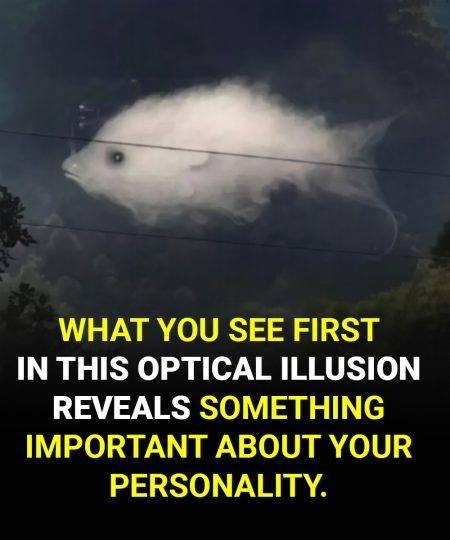
Have you ever looked at an image and instantly seen something different from the person next to you? One moment it appears to be a soft floating cloud, and the next, someone points out a fish hidden within the same shape. Suddenly, you cannot unsee it.
Optical illusions like this have fascinated people for generations. They are not only entertaining visual puzzles but also intriguing conversation starters about perception and personality. One popular illusion asks a simple question: do you see a cloud or a fish first? While the answer is not a scientific diagnosis, it can offer an interesting glimpse into how you process information and relate to the world around you.

What Is an Optical Illusion
An optical illusion is an image that tricks the brain into perceiving something differently from objective reality. According to the American Psychological Association, perception is not a direct recording of the world but an interpretation shaped by prior experience, expectations, and attention.
When we look at an ambiguous image, the brain quickly searches for familiar patterns. It fills in gaps and organizes shapes based on memory and context. That is why two people can look at the same picture and see completely different objects at first glance.
The cloud-or-fish illusion plays with overlapping outlines and subtle shading, allowing the brain to lock onto one interpretation before noticing the alternative.
If You See a Cloud First
If your eyes are drawn to a cloud first, you may lean toward imagination and reflection. Clouds are soft, shifting, and symbolic. In personality discussions, noticing a cloud can suggest a tendency to focus on atmosphere and emotion before structure and detail.
People who resonate with this interpretation are often described as intuitive and empathetic. They may be quick to sense emotional shifts in a room or pick up on subtle cues in conversations. This attentiveness can foster strong relationships and creative thinking.
From a psychological perspective, individuals who prioritize broad, abstract shapes sometimes display what researchers call global processing. Global processors tend to see the bigger picture before focusing on specific components. This style can be linked to creativity and storytelling, as it emphasizes themes and connections.
However, heightened sensitivity may occasionally lead to overanalyzing situations or dwelling on past experiences. Recognizing this tendency can help transform reflection into action. Creative ideas gain strength when paired with practical steps.
If You See a Fish First
If you notice the fish first, you might have a more analytical and detail-oriented mindset. Fish shapes in illusions often appear more defined, with clear boundaries that stand out from surrounding forms.
Spotting the fish quickly can suggest attentiveness to structure and precision. In daily life, this might translate into strong problem-solving skills and adaptability. Individuals who favor concrete figures often excel at identifying patterns, organizing tasks, and responding calmly under pressure.
Psychological research on visual perception indicates that some people naturally engage in local processing, focusing on specific elements before integrating them into a larger whole. This style can be advantageous in technical work, strategic planning, and decision-making.
While practicality is a strength, it is equally valuable to balance logic with emotional expression. Sharing thoughts and feelings openly can deepen personal and professional connections.

Why People See Different Things First
The question remains: why does one person see a cloud while another sees a fish?
Neuroscientists explain that perception is influenced by top-down processing. This means the brain uses existing knowledge, mood, and expectations to interpret incoming visual data. According to research published by organizations such as Harvard University, our brains constantly predict what we are likely to see, then adjust those predictions based on sensory input.
Mood can also play a role. Someone feeling relaxed may gravitate toward softer, symbolic imagery. Someone focused on tasks may lock onto defined outlines more quickly. Cultural background, personal interests, and even recent conversations can subtly prime perception.
Importantly, what you see first is not a permanent label. If you revisit the illusion later, perhaps in a different emotional state, you might notice the alternative image immediately. This flexibility highlights how dynamic human perception truly is.
The Science Behind Ambiguous Images
Ambiguous images, sometimes called bistable images, have been widely studied in cognitive psychology. They demonstrate that perception is an active process rather than a passive one.
When faced with ambiguity, the brain attempts to reduce uncertainty by committing to a single interpretation. Once that interpretation forms, it becomes temporarily dominant. Over time, or with conscious effort, the brain can switch to another interpretation.
The National Institute of Mental Health notes that perception and cognition are deeply intertwined. Attention, memory, and emotion all influence how we interpret sensory information.
Optical illusions remind us that what feels immediate and obvious may actually be shaped by subtle internal processes.

Cultural Meaning of Clouds and Fish
Beyond psychology, clouds and fish carry symbolic meanings in many cultures.
Clouds are often associated with imagination, change, and contemplation. In literature and art, they symbolize dreams, transition, and emotional depth. Seeing a cloud first may resonate with people who naturally think in metaphors or appreciate abstract beauty.
Fish, on the other hand, frequently symbolize adaptability and resourcefulness. In various traditions, fish represent movement, awareness, and survival within shifting environments. Noticing a fish first might align with individuals who value practicality and resilience.
While these interpretations are symbolic rather than scientific, they add an additional layer of reflection to the illusion. They encourage us to consider how personal associations shape what we notice.
Optical Illusions as Tools for Self Reflection
It is important to approach personality-based optical illusions with balance. They are not psychological assessments or clinical tools. Instead, they serve as prompts for curiosity.
Engaging with illusions can encourage mindfulness. They invite us to pause and observe how quickly our minds jump to conclusions. They also highlight how flexible perception can be.
Rather than asking which answer is correct, a more meaningful question might be why a certain image stood out at a particular moment. What were you thinking about? How were you feeling? What patterns do you typically notice in daily life?
By exploring these questions, illusions become opportunities for gentle self-awareness rather than rigid categorization.
The Subjective Nature of Perception
One of the most powerful lessons from optical illusions is that perception is subjective. Two people can look at the same image and sincerely experience different realities, at least initially.
This insight extends beyond visual puzzles. In conversations, work environments, and relationships, individuals interpret situations through unique mental filters shaped by experience and emotion.
Recognizing this subjectivity can foster empathy. Just as someone else may see a fish where you see a cloud, they may interpret events differently based on their own perspective.
Understanding this can reduce misunderstandings and encourage open dialogue.
A Gentle Reminder About Personality Labels
Modern culture often seeks quick personality labels. Quizzes and viral images promise instant insight. While they can be entertaining, human personality is far more complex than a single visual choice.
Traits exist on spectrums. Context matters. Growth and change are constant. The cloud-or-fish illusion captures only a fleeting snapshot of attention in a specific moment.
Approaching such tools with curiosity rather than certainty allows them to remain lighthearted and constructive.

Conclusion: Curiosity and the Mind
The simple question of whether you see a cloud or a fish first reveals something deeper than personality traits. It reveals how actively and creatively your brain constructs reality.
Optical illusions remind us that perception is not fixed. It shifts with mood, memory, and focus. They encourage us to slow down, look again, and appreciate the complexity of our own minds.
In a fast-paced world filled with information, taking a moment to explore how we see can be both calming and enlightening. Whether you spotted a cloud drifting across the image or a fish swimming through it, the real discovery lies in recognizing how wonderfully adaptable human perception truly is.
Curiosity about what we see and why we see it keeps us learning, reflecting, and connecting with one another. And sometimes, all it takes is a simple illusion to remind us of that.
Sources
American Psychological Association. Resources on perception and cognitive processing.
Harvard University. Research on top-down processing and visual cognition.
National Institute of Mental Health. Information on brain function and perception.
Psychology Today. Articles discussing global and local processing styles in visual perception.











Leave a Reply