
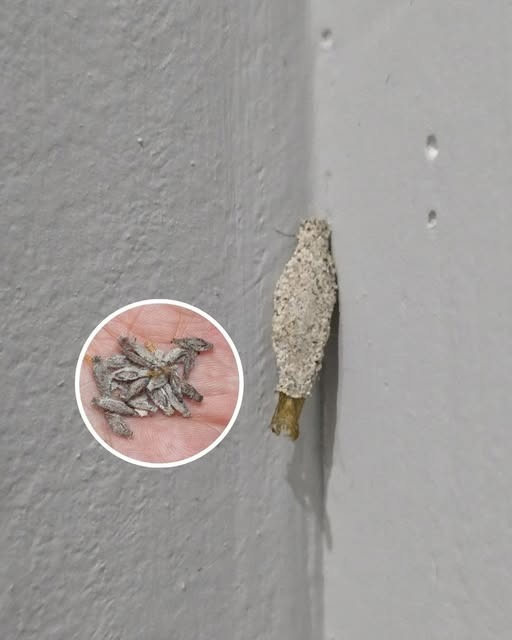
If you have spent time scrolling through social media lately, you may have seen a striking image: a large, fuzzy moth pressed flat against a wall, its wings spread wide with bold, eye-like markings. The caption usually includes a dramatic warning about a painful sting and identifies the insect as the “Kamitetep moth,” often paired with the scientific name Tetrablemma kamitetep. Some posts even claim it was discovered in a remote place called “Shaw Forest” or “Shaw Jungle.”
The image looks convincing. The details appear precise. The scientific name sounds formal. Yet despite its viral popularity, the Kamitetep moth is not a documented species. It is an internet creation — a carefully designed piece of speculative biology art.

A Scientific Name That Does Not Add Up
One of the first clues lies in the name itself.
The term Tetrablemma is not invented, but it does not belong to moths. It is an established genus of small spiders. The use of that genus name for a supposed moth immediately raises questions. Scientific classification follows strict conventions, overseen by institutions and recorded in global taxonomic databases.
If a new moth species were discovered, it would be cataloged through formal publication and recognized by entomological authorities such as the Smithsonian Institution or listed in biodiversity databases maintained by organizations like the International Union for Conservation of Nature.
No such records exist for a species called Tetrablemma kamitetep.
The Suspicious Habitat
Posts often claim the Kamitetep moth inhabits “Shaw Forest” or “Shaw Jungle.” However, no widely recognized biological survey or geographic record confirms a habitat by that name linked to a newly identified moth species.
When new insects are discovered, their locations are typically described with precision — coordinates, ecological zones, elevation data, and collection records. Reputable institutions such as the Natural History Museum maintain extensive archives of verified specimens.
In the case of the Kamitetep moth, there are no museum specimens, peer-reviewed papers, or field studies supporting its existence.

Design Clues in the Image
Beyond the name and habitat claims, the insect’s appearance itself contains subtle hints.
The moth’s posture is unusually flat and geometrically symmetrical. While many real moths display symmetry, the precision in the viral image appears stylized. The thick, plush-like fuzz and evenly spaced patterns resemble digital illustration techniques more than natural variation.
Speculative biology art has grown in popularity in recent years. Digital artists create fictional organisms that mimic real evolutionary principles while intentionally introducing exaggerated or dramatic features. The Kamitetep image appears to fall into this category.
The addition of a warning about a painful sting further enhances engagement. However, it is worth noting that moths, as members of the order Lepidoptera, generally do not sting. While some caterpillars have defensive hairs, adult moths do not possess stingers like bees or wasps.
Why the Myth Spread So Easily
The Kamitetep moth’s viral success is not accidental. It taps into several psychological triggers.
First, it resembles real phenomena. Many moths use eye-like wing patterns to deter predators. This strategy, known as eyespot mimicry, is well documented in entomology.
Second, it plays on the idea of undiscovered biodiversity. Scientists estimate that millions of insect species remain undocumented worldwide. That uncertainty leaves room for plausible-sounding fabrications.
Finally, the suggestion of danger encourages sharing. Posts that imply hidden risks often generate more engagement.
In short, the Kamitetep myth blends familiarity, mystery, and mild alarm — a combination that performs well on social media.
Real Moths That Rival Fiction
Ironically, nature already offers examples that are just as astonishing as any digital creation.
The Venezuelan Poodle Moth gained attention for its fluffy appearance and teddy-bear-like face. The Atlas Moth is one of the largest moths in the world, with wing patterns that resemble snake heads. The Madagascan Sunset Moth displays iridescent colors that shimmer in daylight. Clearwing moths have transparent wings that mimic wasps.
Each of these species has been documented, photographed, and studied by scientists. Their existence is supported by field research and preserved specimens.
A Reminder About Digital Literacy
The Kamitetep moth serves as a reminder that not everything presented with scientific language is genuine. Latin names, habitat claims, and dramatic descriptions can create an illusion of authenticity.
When encountering extraordinary wildlife posts, it can help to verify the source. Is the species listed in credible biodiversity databases? Has it been reported by recognized research institutions? Are there peer-reviewed references?
As digital art tools become more advanced, fabricated organisms may continue to blur the line between imagination and reality.
Curiosity in the Age of Viral Discovery
The fascination with the Kamitetep moth reveals something positive about human nature. People are curious about the natural world. They are intrigued by rare creatures and hidden corners of biodiversity.
That curiosity drives scientific discovery. It also makes us vulnerable to convincing illusions.
In this case, the wall-clinging moth is not a new species waiting to be studied. It is a creative expression designed to spark wonder and conversation.
Yet perhaps that is part of its appeal. Even when the creature turns out to be fictional, the sense of amazement it evokes reflects a deeper truth: nature itself is extraordinary enough that a well-crafted myth can seem believable.
And in a world where images travel faster than facts, curiosity remains our most valuable tool — not just for discovering new species, but for distinguishing imagination from reality.











Leave a Reply