
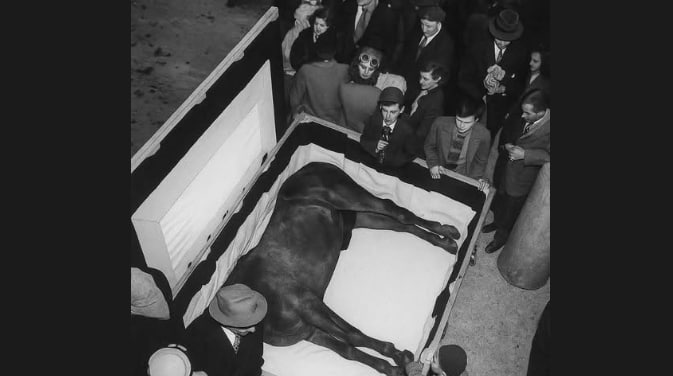
On a quiet November day in 1947, visitors gathered at Faraway Farm in Kentucky to witness a moment that felt almost surreal. Before them lay a legendary Thoroughbred in a solid oak coffin, resting just outside his familiar stall. Draped in his racing colors, he was honored not merely as a racehorse, but as a national icon. When Man o’ War passed away on November 1, 1947, at the age of 30, what appeared to be a heart attack marked the end of an era in American horse racing.
More than 2,500 people traveled to pay their respects. His funeral was broadcast live on NBC radio, an extraordinary tribute that reflected his cultural impact. For many fans, this was not simply the loss of a champion athlete, but the farewell of a symbol of excellence and pride.

A Racing Career That Defined Greatness
Foaled in 1917, Man o’ War quickly became one of the most dominant racehorses in history. He won 20 of his 21 starts, often by remarkable margins. His speed, stride, and competitive spirit earned him the nickname “Big Red,” a title later shared with other notable racehorses but first made famous by him.
At a time when horse racing was one of the most popular sports in the United States, Man o’ War captivated the public. Newspapers followed his every race. Crowds filled grandstands to watch him compete. His performances were described in almost mythic terms, reinforcing his status as a living legend.
Even after retiring to stud at Faraway Farm, his influence continued. He sired numerous successful offspring, most notably War Admiral, who would go on to win the Triple Crown in 1937. Through his lineage, Man o’ War helped shape the future of Thoroughbred racing.
A Funeral Unlike Any Other
The decision to embalm Man o’ War was unprecedented. He became the first horse known to receive such treatment, reflecting the immense respect he commanded. His oak coffin was placed near his stall, allowing visitors to pass by and offer their respects.
The image of a racehorse lying in state may seem unusual, but it highlights the depth of admiration people felt. Broadcasting the funeral live on NBC radio further demonstrates how significant he was to the public. In 1947, radio was a primary source of information and entertainment. To dedicate airtime to a horse’s memorial service illustrates the magnitude of his fame.
This ceremony blended elements of tradition and innovation. It honored both his athletic achievements and his emotional connection to fans.
Cultural Meaning and Symbolism
In American culture, exceptional racehorses often become symbols of ambition, determination, and national pride. During the early twentieth century, Thoroughbred racing represented more than sport. It was a social event, a business enterprise, and a shared national pastime.
Man o’ War’s funeral can be viewed through this cultural lens. His public memorial resembled tributes typically reserved for prominent human figures. While some observers may interpret this as extraordinary, it also reflects humanity’s longstanding bond with animals who inspire collective admiration.
Horses have held symbolic importance for centuries. From ancient war steeds to modern race champions, they represent strength and partnership. In honoring Man o’ War so publicly, admirers were also honoring the ideals he embodied.
The Scientific Perspective: Longevity and Care
Reaching 30 years of age was notable for a Thoroughbred in the mid-twentieth century. Advances in veterinary medicine have since improved equine health and longevity, but at that time, such an age was respectable.
The apparent heart-related cause of his passing aligns with what veterinarians recognize today as natural age-associated conditions in horses. As with humans, cardiac events can occur without prolonged warning signs, particularly in aging animals.
His embalming was also scientifically significant. Preserving the body of a horse required specialized knowledge and adaptation of human embalming techniques. This step reflected both reverence and a desire to maintain dignity in presentation.
Eventually, Man o’ War was interred at Kentucky Horse Park, where a bronze statue now stands in his honor. His burial site continues to attract visitors, demonstrating that interest in his legacy has endured for generations.
Media, Memory, and Public Fascination
The live radio broadcast of his funeral underscores the evolving relationship between media and celebrity. In the 1940s, national broadcasts were reserved for events of considerable importance. Covering the memorial of a racehorse highlights how deeply embedded he was in public consciousness.
Such widespread attention may appear surprising today, yet it aligns with the era’s enthusiasm for sporting heroes. Without television or digital platforms, radio united listeners in shared experiences. Through sound alone, audiences participated in a moment of collective remembrance.
This blend of sport, media, and emotion contributed to the mythic aura surrounding Man o’ War. Over time, stories of his speed and dominance have grown into legend, sometimes amplified by nostalgia.

Balancing Legend and Reality
It is tempting to frame Man o’ War’s life and funeral as entirely extraordinary. While the scale of public mourning was indeed unusual, it can also be understood within historical context. He competed during a golden age of racing, when horses were central to American leisure culture.
Separating myth from documented history allows us to appreciate his achievements without exaggeration. Records confirm his dominance on the track. Contemporary accounts verify the large attendance at his funeral and the radio coverage. These facts alone are impressive.
At the same time, the emotional dimension cannot be ignored. The sight of thousands quietly passing by his oak coffin speaks to something deeper than statistics.
A Legacy That Endures
Today, Man o’ War remains a benchmark for greatness in Thoroughbred racing. His name appears in discussions of the greatest racehorses of all time. Historians and enthusiasts continue to analyze his races, bloodlines, and influence on breeding.
More than seven decades later, his story still resonates. Not only because of his victories, but because of the remarkable farewell that followed his life.

Reflection: Why We Remember
Why does the story of a racehorse’s funeral still captivate us? Perhaps it is because it reveals how deeply humans connect with animals who inspire awe. We project ideals onto them, celebrate their triumphs, and mourn their absence.
Man o’ War’s memorial illustrates our enduring curiosity about excellence and legacy. It reminds us that admiration can transcend species, and that memory is shaped not only by facts, but by feeling.
In honoring a champion with dignity and ceremony, people were also acknowledging the role he played in their lives. Through curiosity, storytelling, and shared remembrance, legends endure long after the final race is run.


Leave a Reply