
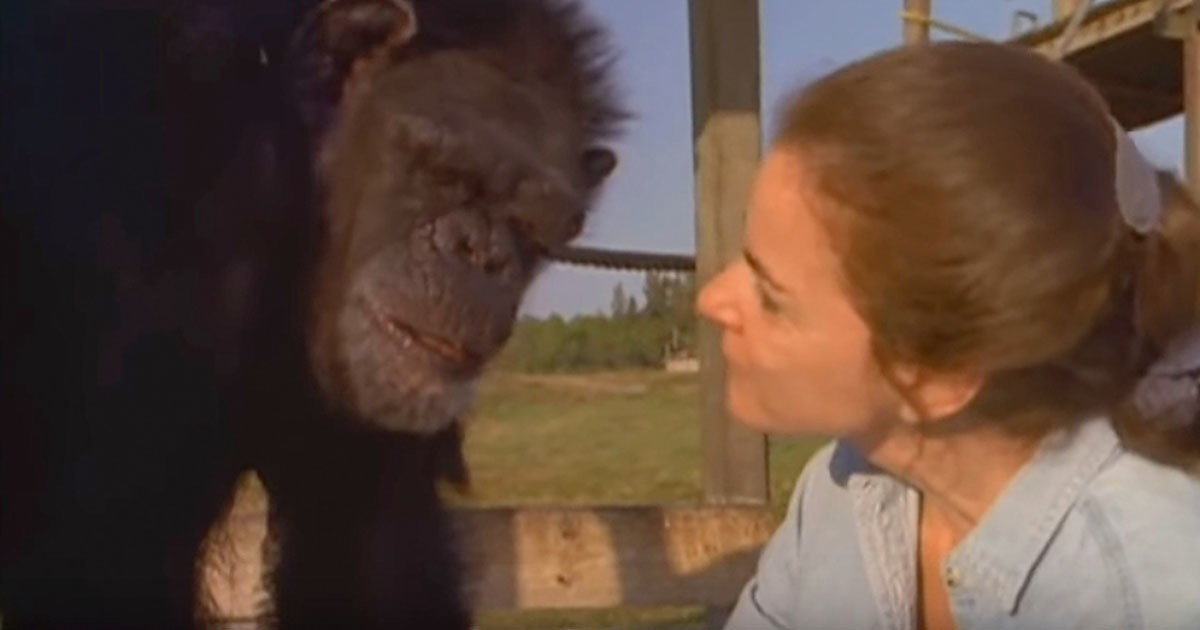
An Emotional Chimpanzee Reunion After 18 Years
When Linda Koeb stepped back into the animal reserve after nearly two decades, she carried one overwhelming question in her heart:
Would they remember her?
Eighteen years earlier, she had said goodbye to two chimpanzees she helped rescue and rehabilitate — Swing and Doll. At the time, she had no way of knowing whether she would ever see them again.
What happened during their reunion would later move millions around the world.
The chimpanzee reunion after 18 years became a powerful reminder of animal intelligence, emotional memory, and the deep bonds that can form between humans and wildlife.

From Laboratory Captivity to a Second Chance
Linda first met Swing and Doll when she was just 23 years old. At the time, she was a student who began working with chimpanzees that had recently been released from a laboratory environment.
For six years, the two chimps had been subjected to medical and behavioral testing. Like many lab animals, they had spent much of their lives in confinement — removed from natural surroundings, social groups, and normal development.
When they were finally transferred out of the lab, they needed rehabilitation before being released into a protected reserve.
That’s where Linda came in.
For the next four years, she dedicated herself to helping Swing and Doll adjust to life outside laboratory walls. She worked patiently to rebuild their confidence, encourage natural behaviors, and prepare them for a future in a semi-wild environment.
Rehabilitation for primates is not simple. It involves:
-
Teaching survival behaviors
-
Encouraging social bonding
-
Monitoring stress levels
-
Helping them adapt to climate and terrain
Linda formed a deep connection with both chimpanzees during that time.

A Difficult Goodbye
When Swing and Doll were finally ready to be released into the reserve, it marked both a triumph and a heartbreak.
After years in captivity, adapting to open space, unpredictable weather, and new social dynamics was not guaranteed to succeed.
Linda worried constantly about whether they would adjust.
She vividly remembered watching them step into their new world for the first time. Having spent six years in a laboratory before rehabilitation, they faced enormous change.
But with time — and the foundation Linda helped build — the chimpanzees gradually adapted.
They learned to explore, forage, and interact more naturally. Over time, they appeared to settle into a healthier and more fulfilling life.
Then Linda stepped away.
Life moved forward.
Eighteen years passed.
Returning After Nearly Two Decades
Nearly two decades later, Linda made the decision to return to the reserve.
Chimpanzees are incredibly strong animals. Adult chimps possess significant physical power — far greater than humans in terms of upper body strength. Because of this, handlers and animal care professionals are always cautious when it comes to close contact.
Reserve staff were unsure whether it would be safe for Linda to approach Swing and Doll.
After 18 years without contact, there was no guarantee of recognition.
Chimpanzees can display aggression, especially if they feel threatened or confused. Even a moment of misunderstanding could result in injury.
But Linda felt compelled to try.
The moment was captured on video — later shared widely online under titles such as “Emotional Reunion with Chimpanzees.”

The Moment of Recognition
As Linda cautiously approached, observers held their breath.
Would the chimpanzees see her as a stranger?
Or would something deeper remain?
What happened next surprised even the most cautious onlookers.
Swing and Doll responded with unmistakable excitement. They vocalized, reached out, and embraced her — displaying clear signs of recognition and affection.
There was no aggression.
No hesitation.
Only what appeared to be joy.
The chimpanzee reunion after 18 years quickly became a viral moment — not because it was dramatic, but because it was deeply emotional.
It challenged assumptions about how animals remember — and whom they remember.
Do Chimpanzees Really Remember People?
Scientific research supports the idea that chimpanzees possess strong long-term memory abilities.
Studies have shown that chimpanzees can:
-
Recognize faces after years of separation
-
Remember complex tasks and patterns
-
Maintain social memory of group members
-
Exhibit emotional attachment behaviors
Chimpanzees share approximately 98–99% of their DNA with humans. Their cognitive and emotional capacities are among the most advanced in the animal kingdom.
They kiss, hug, groom, shake hands, and reconcile after conflict. They form alliances. They grieve. They celebrate reunions.
Memory, particularly social memory, plays a vital role in chimpanzee society.
Linda’s reunion with Swing and Doll aligns with what researchers have observed: emotional bonds can persist even across long periods of separation.

The Power of Early Compassion
What makes this story especially powerful is the role Linda played during a critical window in the chimpanzees’ lives.
Rehabilitation is more than physical care. It involves emotional rebuilding.
Swing and Doll had spent six formative years in a laboratory setting. During their rehabilitation, Linda provided:
-
Consistency
-
Gentleness
-
Positive reinforcement
-
Emotional safety
These elements likely contributed not only to their successful adaptation — but also to the memory of her presence.
When she returned 18 years later, it may not have been just her face they remembered — but the sense of safety associated with her.
Why This Reunion Resonates Worldwide
The chimpanzee reunion after 18 years struck a chord with viewers for several reasons:
1. It Challenges Assumptions About Animal Emotions
Many people underestimate the emotional depth of animals. Moments like this suggest otherwise.
2. It Highlights the Impact of Ethical Rehabilitation
Animals removed from harmful environments can recover with proper care and patience.
3. It Shows That Kindness Has Long-Term Effects
Linda’s early compassion may have left a lifelong imprint.
A Broader Conversation About Lab Animals
Stories like Swing and Doll’s also spark discussion about the use of animals in laboratory research.
Over the past decades, there has been increasing global scrutiny regarding the ethics of primate testing. Many countries have strengthened regulations or banned invasive testing on great apes altogether.
Rehabilitation and sanctuary programs have become essential in providing former lab animals with safer, enriched environments.
While this reunion is heartwarming, it also serves as a reminder of the resilience animals demonstrate after hardship.
The Enduring Bond Between Humans and Animals
Eighteen years is a long time in any life — human or animal.
Yet when Linda stood before Swing and Doll again, time seemed to collapse.
Their reunion did not require language.
It did not require explanation.
It was expressed through touch, sound, and unmistakable emotional recognition.
Who says chimpanzees cannot love the person who once saved them?
If anything, this story suggests that love — when shown with patience and sincerity — can endure far longer than we imagine.
Final Thoughts
The chimpanzee reunion after 18 years is more than a viral video.
It is a testament to memory.
To resilience.
To the lasting power of compassion.
Linda Koeb helped give Swing and Doll a second chance at life.
Nearly two decades later, they appeared to give something back — recognition, affection, and proof that bonds formed through kindness are not easily broken.
In a world often filled with fleeting interactions, this reunion reminds us that some connections truly stand the test of time.


Leave a Reply