
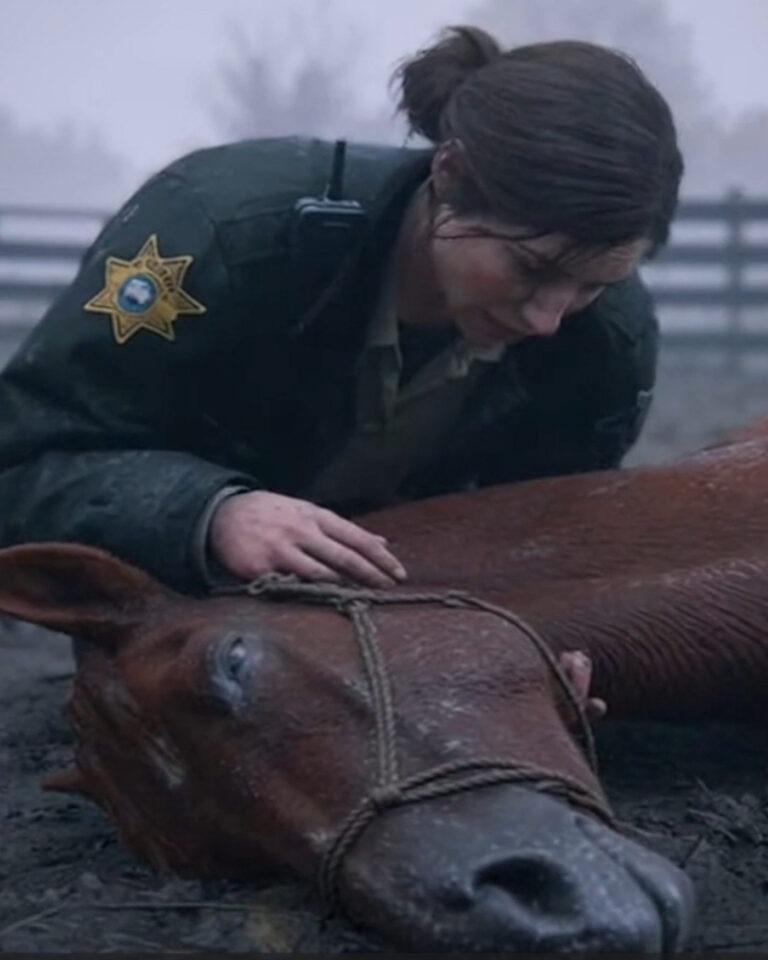
The mud swallowed her boots first.
Cold rain drifted across the back pen as Deputy Lara stepped forward, ignoring the sting in her legs. Ahead of her lay a chestnut mare, motionless in the thick earth. The sky hung low and gray, and the air felt heavy with silence.
The animal’s breathing was shallow. Her coat, once glossy, was dulled by mud. Her body trembled from exhaustion and exposure. The veterinarian was on the way, but the next twenty minutes would matter.
So Lara knelt.
She slid her arm beneath the mare’s neck and lifted gently, cradling the heavy head into her lap. The mare leaned into her, as if seeking warmth and stability. Rain soaked through fabric and skin, but Lara stayed.
That quiet moment in the mud became more than a rescue scene. It became a story about connection, endurance, and the remarkable bond between humans and horses.

Understanding Hypothermia in Horses
When animals are exposed to prolonged cold and wet conditions, their bodies can lose heat faster than they generate it. According to the American Association of Equine Practitioners, horses generally tolerate cool temperatures well due to their size and natural insulation. However, extreme wet conditions combined with wind can significantly increase heat loss.
Hypothermia in horses may present as weakness, slowed responsiveness, and shallow breathing. Immediate steps typically include keeping the animal upright if possible, providing insulation with blankets, and administering warmed fluids under veterinary supervision.
In the pen that afternoon, Lara had only one tool before the veterinarian arrived: her presence. By lifting the mare’s head and preventing further exposure to cold ground, she helped conserve what little warmth remained.
The Science of Staying Present
Why does human contact sometimes appear to calm distressed animals?
Research suggests that horses are highly sensitive to body language and tone of voice. The University of Sussex has published studies indicating that horses can distinguish human emotional cues, responding differently to calm versus tense expressions.
A steady voice and gentle touch can reduce visible signs of stress in some equine situations. While this does not replace medical treatment, it may help stabilize an animal until professional care arrives.
As Lara spoke softly and maintained rhythmic strokes along the mare’s neck, she likely provided a sensory anchor. In stressful environments, predictable stimuli can support physiological regulation.

Horses in Human History and Culture
The bond between humans and horses stretches back thousands of years. From transportation to agriculture, from sport to companionship, horses have shaped civilizations.
In many cultures, horses symbolize endurance and loyalty. In Greek mythology, the winged horse Pegasus represented strength and transcendence. In East Asian traditions, horses often appear as symbols of perseverance and vitality.
These cultural meanings deepen the emotional weight of rescue stories. When a horse struggles and a human remains at its side, the moment resonates beyond biology. It reflects an ancient partnership built on trust and cooperation.
However, while symbolism adds richness, modern veterinary science remains essential. Compassion and knowledge work best together.
Emergency Equine Care: What Experts Recommend
When a horse is found in a compromised condition, rapid assessment is critical. The American Veterinary Medical Association advises contacting a licensed veterinarian immediately in cases involving collapse, prolonged recumbency, or signs of shock.
Common emergency interventions may include fluid therapy, temperature stabilization, and monitoring heart rate and respiration. Attempting complex procedures without professional guidance can risk further complications.
In Lara’s case, she followed direct instructions from the veterinarian over the phone. Keep the mare warm. Keep her responsive. Prevent her from shutting down.
These steps align with established emergency protocols.
The Psychology of Animal Rescue
Why do individuals sometimes place themselves in uncomfortable or even risky situations to assist animals?
Psychologists describe a phenomenon known as empathic concern, the capacity to feel and respond to another being’s distress. This response is not limited to interactions between humans. Studies suggest that empathy can extend across species boundaries, particularly when vulnerability is visible.
The Humane Society of the United States emphasizes that humane response training for first responders often includes recognizing signs of animal distress and applying calm, measured interventions.
For many rescue workers, staying present is as important as acting quickly. Emotional steadiness can influence outcomes by reducing chaos and maintaining focus.

Resilience in Large Animals
Horses are powerful animals, yet they can be vulnerable when weakened by environmental stress. Their size makes lifting or repositioning difficult, and prolonged immobility may complicate recovery.
Despite this, horses possess significant physiological resilience. With prompt veterinary care, many recover from acute cold stress and exhaustion. Muscle memory, cardiovascular strength, and adaptive responses support recovery when intervention occurs in time.
In the muddy pen, the mare’s breathing gradually steadied. Whether influenced by warmth, reduced stress, or sheer biological determination, she continued to inhale and exhale in rhythm with Lara’s presence.
When Help Arrives
The sound of headlights cutting through gray rain signaled relief. The veterinarian and team entered with equipment and blankets. Fluids were prepared. The mare was stabilized and carefully lifted onto a stretcher.
Lara remained close until she felt a faint but steady pulse beneath her hand.
That final gesture, pressing her forehead gently to the mare’s, carried symbolic weight. It represented the transition from uncertainty to cautious hope.
Stories like this often circulate widely because they capture a universal theme: the refusal to leave something vulnerable alone.
![Review Game] The Last of Us Part II: Cái vòng luẩn quẩn của ...](https://s3.cloud.cmctelecom.vn/tinhte2/2020/06/5046556_TLOUPII_Review_Screenshot_11.jpg)
Myth and Reality in Rescue Narratives
It can be tempting to frame such events as miraculous. However, responsible storytelling balances emotion with accuracy.
The mare’s survival was not magic. It was the result of early recognition, adherence to veterinary guidance, and coordinated response. Extraordinary recoveries often appear dramatic, yet they are grounded in timely intervention and biological capability.
Speculation may surround moments of apparent connection between human and animal, but scientific understanding offers plausible explanations. Calm touch can reduce stress. Stability can conserve energy. Warmth can slow heat loss.
When myth and science intersect, the truth often lies in their combination.
A Reflection on Human Curiosity and Compassion
Why do stories of animals in distress captivate us so deeply?
Perhaps because they remind us of shared vulnerability. Mud, cold, exhaustion, and fear are experiences not limited by species. When one being chooses to remain beside another during hardship, it reflects a universal instinct toward care.
Curiosity drives us to ask what the mare felt in those moments. Science tells us about stress hormones and thermal regulation. Culture tells us about loyalty and endurance. Together, they shape how we interpret the scene.
In the end, the most powerful element may be the simplest. Someone stayed.
Deputy Lara did not know whether the mare would recover fully. She could not control every variable. What she could do was refuse to let the animal face those minutes alone.
Human curiosity leads us to explore how animals think, feel, and survive. Compassion leads us to act when they struggle. Between those two forces lies the quiet space where science and empathy meet.
And sometimes, as that muddy pen revealed, staying present is enough to help a heart keep beating.
Sources
American Association of Equine Practitioners. Cold Weather Care Guidelines for Horses.
American Veterinary Medical Association. Emergency Care for Large Animals.
University of Sussex. Research on Equine Perception of Human Emotions.
Humane Society of the United States. Humane Response and Animal Rescue Resources.



Leave a Reply