
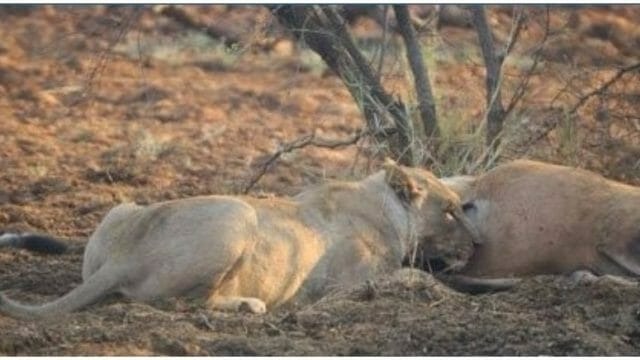
In the golden light of late afternoon on the African savannah, a safari vehicle rolled quietly through tall grass in South Africa’s famed reserve. The group on board expected to witness the raw rhythms of nature: a hunt, a chase, perhaps a distant roar. What they did not expect was a moment that would challenge long-held assumptions about animal emotion.
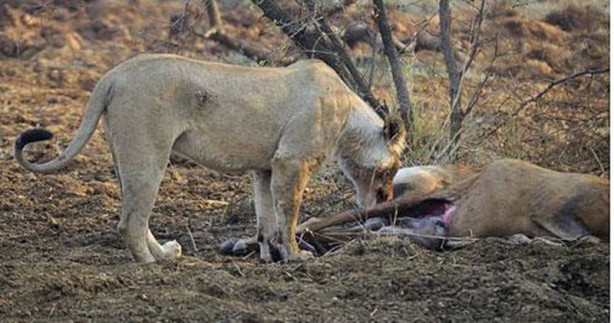
According to witnesses, a lioness had successfully hunted a large antelope. Such scenes are a natural part of life in the wild, especially in protected ecosystems like Madikwe Game Reserve. But what unfolded next captured global attention. When the lioness discovered the antelope was carrying an unborn calf, her behavior appeared to shift. She paused, stepped back, and began interacting with the small body in a manner that observers described as unusually gentle.
Was it compassion? Instinct? Confusion? The story quickly spread online, raising profound questions about the emotional lives of animals and the fine line between interpretation and evidence.

The Setting: Life in Madikwe Game Reserve
Madikwe Game Reserve is one of South Africa’s largest wildlife conservation areas. Known for its “Big Five” sightings, the reserve plays a critical role in habitat protection and species management.
Lions in Madikwe live as apex predators within a carefully balanced ecosystem. Their hunting behavior supports population control and ensures ecological stability. For safari guides and wildlife photographers, witnessing a hunt is not uncommon. It reflects the natural order of predator and prey that has existed for millennia.
On this particular outing, the safari was led by experienced guide Gerry Van Der Walt. He later described the encounter as one of the most unusual he had ever observed in his career.
The Unexpected Pause
After bringing down the antelope, the lioness reportedly began feeding, as predators typically do. But upon discovering the unborn calf, her movements slowed. Witnesses said she gently removed it and placed it on the ground.
According to Gerry Van Der Walt, the lioness appeared tense and alert. She nudged the calf with her nose and examined it carefully. At one point, she reportedly lifted it by the back of the neck, a behavior commonly seen when lionesses carry their own cubs.
Eventually, she placed the small body in tall grass near a bush and remained nearby for some time. Observers described the scene as solemn and unexpected. The lioness did not immediately resume feeding and instead stayed close to the area.
Video clips and written accounts circulated widely, prompting emotional reactions from viewers around the world.

Lions in Culture: Symbols of Strength and Majesty
Lions have long occupied a powerful place in human storytelling. Often referred to as the “king of the jungle,” they symbolize courage, dominance, and leadership across cultures. From ancient African folklore to European heraldry, lions represent strength and authority.
Stories that reveal a softer side of lions tend to resonate deeply because they contrast with this traditional image. When a predator displays what appears to be gentleness, it challenges our expectations. The narrative becomes not just about wildlife but about empathy, morality, and shared emotion.
In this case, many interpreted the lioness’s actions as compassion or even regret. The image of a powerful hunter pausing in apparent reflection struck a chord with audiences who seek connection in the natural world.
Scientific Perspectives on Predator Behavior
While the story inspired strong emotional reactions, wildlife scientists approach such events with careful analysis. Animal behavior is shaped by instinct, experience, hormonal states, and environmental cues.
Research published by organizations such as the National Geographic Society and studies in behavioral ecology suggest that maternal instincts in mammals are deeply rooted. A lioness interacting with a small, newborn-shaped body may be responding to innate caregiving triggers rather than conscious reflection.
Large carnivores are known to display investigative behavior when encountering unfamiliar stimuli. Nudging, sniffing, and carrying are ways animals gather information. In some cases, predators have been observed pausing during hunts due to confusion or heightened alertness.
It is also important to consider that wildlife encounters are brief snapshots of longer processes. Without controlled study or extended observation, assigning complex emotional motivations can be speculative.
Compassion or Instinct: Why Interpretation Matters
Humans are naturally inclined to anthropomorphize animals. Anthropomorphism helps us relate to other species by projecting familiar emotions onto their actions. While this tendency can deepen empathy and encourage conservation, it can also blur the line between observation and assumption.
The lioness’s behavior may have been influenced by maternal hormones, sensory curiosity, or environmental awareness. Alternatively, it may reflect a capacity for emotional processing that science is still working to understand.
Modern research increasingly acknowledges that animals experience a range of emotional states. Studies of elephants, dolphins, and primates have documented behaviors consistent with social bonding and stress responses. Lions, as social cats living in prides, also demonstrate cooperative care and strong family ties.
However, whether the lioness felt remorse remains impossible to confirm. What can be said with confidence is that her actions were unusual enough to stand out to experienced observers like Gerry Van Der Walt.
The Broader Conversation About Animal Emotion
The event in Madikwe Game Reserve contributes to an ongoing global conversation about animal consciousness. For decades, scientists debated whether nonhuman animals possess self-awareness or complex emotions.
Today, many researchers agree that mammals and birds exhibit cognitive sophistication beyond earlier assumptions. Emotional capacity likely exists along a spectrum rather than as a uniquely human trait.
At the same time, responsible storytelling requires balance. Extraordinary claims deserve thoughtful framing. It is possible to honor the emotional impact of the moment without presenting it as definitive proof of guilt or moral reasoning.
Why the Story Resonated Worldwide
The lioness’s pause during a hunt represents a striking contrast between survival instinct and apparent tenderness. In a world where headlines often emphasize conflict, stories of unexpected gentleness capture attention.
Viewers may see in this moment a reminder that nature is complex and layered. Predators are not villains, and prey are not merely victims. Both play essential roles in sustaining ecosystems.
The lioness did what lions have always done to survive. Yet her hesitation introduced ambiguity into an otherwise predictable scene. That ambiguity invites reflection.
Nature, Morality, and Human Curiosity
What was the lioness thinking? This question lingers not because we expect a clear answer, but because it reflects our own curiosity about consciousness.
Humans often seek moral narratives in the natural world. We look for lessons about compassion, responsibility, and coexistence. While animals operate primarily through instinct, their behaviors can mirror patterns we recognize in ourselves.
The safari sighting does not prove that lions experience guilt in a human sense. It does, however, highlight how much remains unknown about animal cognition. Scientific inquiry continues to evolve, challenging simplistic distinctions between human and nonhuman minds.
In the end, perhaps the most meaningful takeaway is not whether the lioness felt remorse, but how the story inspires deeper respect for wildlife. It encourages us to observe carefully, interpret responsibly, and remain open to new discoveries.
Human curiosity drives both science and storytelling. We are captivated by moments that blur boundaries and invite wonder. Whether viewed through a cultural lens or a scientific one, the lioness of Madikwe reminds us that the natural world is richer and more nuanced than we often assume.
Sources
National Geographic Society. Research and articles on lion behavior and social structure.
Smithsonian National Zoo and Conservation Biology Institute. Studies on large carnivore behavior.
Scientific American. Articles on animal emotion and cognition.
Madikwe Game Reserve Official Information Portal. Wildlife conservation and ecosystem management details.





Leave a Reply