
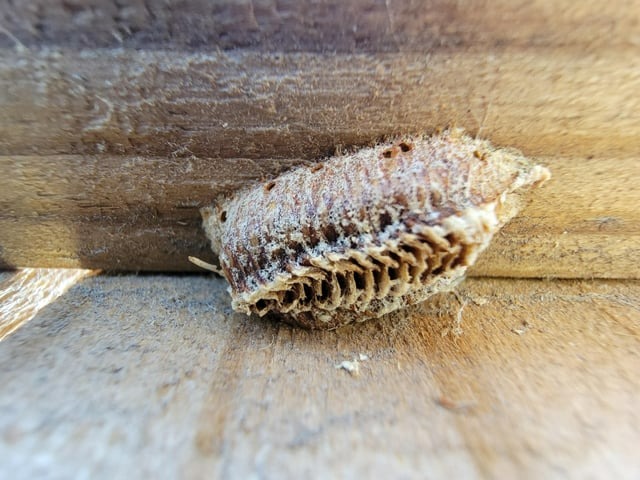
Discovering a strange object in your backyard can instantly trigger curiosity — or concern. If you’ve spotted a firm, brown, foam-like mass attached to a fence post, tree branch, or garden furniture, your first instinct might be to scrape it off.
But before you remove it, pause.
In many cases, that unusual structure is actually a praying mantis egg case, known as an ootheca. While it may look odd or even artificial at first glance, it’s a fascinating and beneficial part of your backyard ecosystem.

What Does a Praying Mantis Egg Case Look Like?
A praying mantis egg case typically appears:
-
Tan to light brown
-
About 1–2 inches long
-
Firm and hardened
-
Slightly foamy or ridged in texture
-
Securely attached to wood, stems, fences, or branches
Its unusual “foam-like” look often causes confusion. Some people mistake it for insulation material, a wasp nest, fungus, or even expanding foam.
In reality, it’s a natural protective casing created by a female mantis to safeguard her eggs through harsh weather conditions.

Meet the Insect Behind It: The Praying Mantis
Praying mantises belong to the order Mantodea. These insects are easily recognized by:
-
Long, slender bodies
-
Triangular heads
-
Large, rotating eyes
-
Folded front legs that look like they’re “praying”
But despite their calm posture, mantises are skilled predators.
They feed on flies, moths, crickets, grasshoppers, caterpillars, and other plant-damaging insects. Because of this, gardeners often consider them beneficial insects — a natural alternative to chemical pest control.
What’s Inside the Ootheca?
In late summer or early fall, a female mantis produces a frothy secretion that surrounds her eggs. Within hours, the foam hardens into a durable shell.
Inside that small structure could be:
-
Dozens
-
Or even hundreds
of tiny mantis eggs.
Throughout winter, the hardened casing protects the developing embryos from:
-
Freezing temperatures
-
Rain and moisture
-
Predators
When spring arrives and temperatures rise, miniature mantises hatch and quickly disperse into nearby plants — ready to hunt almost immediately.
It’s one of nature’s most efficient survival strategies.

Is It Dangerous?
No.
A mantis egg case is completely harmless to:
-
Humans
-
Children
-
Pets
It does not sting, bite, or release toxins. It simply sits dormant until the right conditions trigger hatching.
If you scrape it off and discard it, you unintentionally disrupt the life cycle of beneficial insects that help keep your yard balanced.
Should You Remove It?
In most cases, the best action is to leave it undisturbed.
Only consider relocating it if:
-
It’s in an area likely to be damaged
-
It’s on a movable object you plan to discard
-
It poses a rare structural concern
If relocation is necessary, carefully cut the small branch or section it’s attached to and move it to another sheltered outdoor area.
Avoid crushing or scraping it off.

Why Finding One Is Actually a Good Sign
Spotting a mantis egg case often means your yard supports a healthy ecosystem.
It suggests:
-
Minimal pesticide use
-
Availability of insect prey
-
Balanced garden biodiversity
Rather than being something invasive or harmful, it’s a sign that nature is quietly working in your favor.
Final Thoughts
That hard, foam-like brown structure on your fence post may look unusual — even suspicious. But in many cases, it’s simply a praying mantis ootheca patiently waiting for spring.
Instead of scraping it away, consider it a small piece of backyard wildlife preparing for the next season.
Sometimes, what appears strange at first glance is actually proof that your garden is alive and thriving.









Leave a Reply