
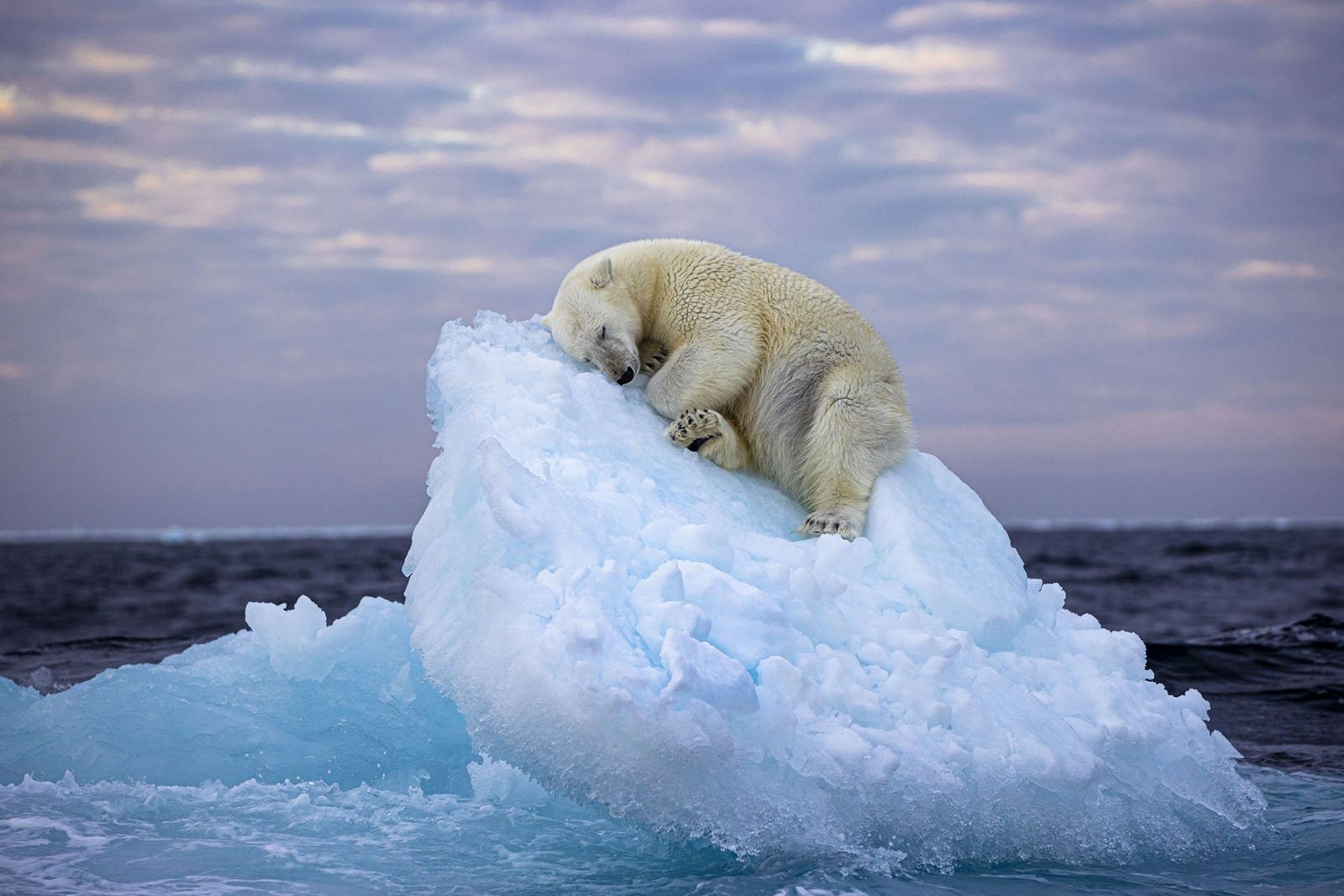
In the stillness of the Arctic, where sea and sky blend into endless shades of white and blue, a young polar bear climbed onto a drifting iceberg and settled into rest. The moment was quiet, almost fragile. Captured through the lens of British photographer Nima Sarikhani, that single image would go on to move hearts across the globe.
The photograph, taken in Norway’s Arctic Ocean, recently won the prestigious People’s Choice Award at the Wildlife Photographer of the Year competition. Chosen from more than seventy five thousand public votes, the image resonated deeply with viewers. It was not dramatic or action filled. Instead, it offered something rarer: a quiet symbol of endurance.
Sarikhani shared that he hopes the image inspires optimism, reminding people that polar bears are resilient and that there is still time to protect their delicate habitat. The story behind this award winning photograph goes beyond art. It touches on climate, conservation, storytelling, and the enduring human fascination with the wild.

The Moment Behind the Lens
Photographing wildlife in the Arctic requires patience, skill, and a willingness to embrace uncertainty. The region’s unpredictable weather and shifting sea ice make each expedition a test of endurance.
During his journey in Norway’s Arctic waters, Nima Sarikhani searched for signs of polar bears across vast frozen landscapes. Hours of scanning the horizon finally paid off when he spotted a young bear navigating floating ice. The animal climbed onto a small iceberg and curled into a resting position.
The composition was striking. The iceberg appeared almost sculptural, rising from dark water like a natural pedestal. At its peak rested the bear, small against the immense Arctic sky. The contrast between scale and vulnerability created a powerful visual narrative.
Rather than portraying struggle, the photograph conveyed calm persistence. It showed a species adapting to its environment, even as that environment continues to change.
The Significance of the Wildlife Photographer of the Year Award
The Wildlife Photographer of the Year competition is organized by the Natural History Museum in London. Established in 1965, it has grown into one of the world’s most respected wildlife photography contests.
Each year, tens of thousands of entries are submitted from photographers around the globe. The People’s Choice Award is particularly meaningful because it reflects the voice of the public. More than seventy five thousand voters selected Sarikhani’s image as their favorite.
The award highlights not only artistic excellence but also the ability of photography to spark conversation about the natural world. Winning images often become ambassadors for conservation, drawing attention to species and ecosystems that might otherwise remain distant from daily life.

Polar Bears: Icons of the Arctic
The polar bear, scientifically known as Ursus maritimus, has become one of the most recognizable symbols of the Arctic. As apex predators, polar bears play a crucial role in maintaining ecological balance within their habitat.
They rely heavily on sea ice as platforms for hunting seals, their primary food source. Sea ice also serves as a space for rest and travel across vast ocean expanses. Because of this dependence, polar bears are closely linked to discussions about climate patterns and environmental change.
Organizations such as the World Wildlife Fund emphasize that Arctic ecosystems are undergoing measurable shifts. Rising global temperatures contribute to seasonal changes in sea ice coverage. Scientists continue to monitor how these changes affect wildlife populations.
At the same time, research shows that polar bears are adaptable animals. They have survived past climate fluctuations and display remarkable resilience in challenging conditions. Sarikhani’s photograph captures this dual reality: vulnerability and strength existing side by side.
The Cultural Meaning of a Polar Bear on Ice
Beyond biology, polar bears hold powerful cultural significance. In Indigenous Arctic traditions, they are respected as intelligent and resourceful beings. In global media, they often represent the broader story of environmental stewardship.
The image of a lone bear resting on a small iceberg naturally invites interpretation. Some viewers see solitude, others see hope. The bear’s posture, calm and composed, contrasts with the vastness of the surrounding ocean.
Photography has long shaped how societies understand distant places. For many people who will never visit the Arctic, images like this become their primary connection to the region. A single frame can influence public perception more effectively than pages of scientific data.
This is where art and science intersect. While climate research provides critical insights, storytelling through imagery engages emotions. Together, they create a fuller understanding.
Resilience in a Changing Landscape
When Nima Sarikhani spoke about his hopes for the image, he emphasized resilience. Rather than presenting the bear solely as a symbol of fragility, he described it as a reminder that there is still time to act.
Conservation experts often stress that environmental outcomes are shaped by collective decisions. Efforts to reduce carbon emissions, protect marine habitats, and support sustainable practices can influence the future of Arctic ecosystems.
The World Wildlife Fund and other research groups continue to collaborate with governments and local communities to develop adaptive strategies. Monitoring population trends, managing human wildlife interactions, and protecting critical habitats are all part of ongoing initiatives.
The resting bear, balanced atop drifting ice, becomes a metaphor for this moment in time. The situation is delicate, yet not without possibility.
The Power of Public Engagement
One of the most striking aspects of this story is the level of public participation. More than seventy five thousand people cast votes in the People’s Choice Award. That number reflects widespread interest in wildlife and conservation.
Public engagement matters. When audiences connect emotionally with a species, they are more likely to support policies and organizations that promote environmental protection. Photography competitions, museum exhibitions, and media coverage play essential roles in fostering that connection.
The Natural History Museum displays winning images in exhibitions that travel internationally. Visitors of all ages encounter scenes from rainforests, deserts, oceans, and polar regions. These experiences can inspire curiosity, empathy, and learning.
In this way, a quiet Arctic photograph becomes part of a much larger conversation about our shared planet.

Between Reality and Representation
It is important to approach powerful images with balance. A single photograph captures one moment, not an entire narrative. While the iceberg may appear isolated, the broader Arctic landscape includes complex networks of ice flows, currents, and wildlife activity.
Similarly, polar bear populations vary across regions. Some groups show signs of stability, while others face greater challenges. Scientists caution against oversimplifying these dynamics.
Sarikhani’s image does not claim to present a complete picture of Arctic conditions. Instead, it offers a visual invitation to learn more. It encourages viewers to ask questions about ecosystems, climate science, and the role humans play in shaping environmental outcomes.
A Reflection on Human Curiosity
Why does an image of a resting polar bear capture global attention? Perhaps because it speaks to something fundamental in human nature. We are drawn to the edges of the world, to places of ice and silence that feel both remote and essential.
Photography allows us to witness moments we could never experience firsthand. It bridges distance and transforms observation into connection. When we see the young bear balanced on its frozen perch, we see more than an animal. We see a story unfolding within a vast, changing world.
Curiosity drives us to explore, to document, and to understand. It also compels us to care. The photograph by Nima Sarikhani reminds us that resilience exists even in fragile places. It suggests that while challenges remain, hope is not misplaced.
In the quiet of the Arctic, a young polar bear rested. Through a camera lens, that simple act became a global symbol. And in our collective gaze, we are reminded that curiosity, compassion, and responsibility often begin with a single image.
Sources
Natural History Museum London. Wildlife Photographer of the Year official website and exhibition materials.
World Wildlife Fund. Polar bear conservation reports and Arctic climate research updates.
National Geographic. Articles on Arctic ecosystems and polar bear behavior.
International Union for Conservation of Nature. Polar bear population assessments and environmental data.






Leave a Reply